Saturday, December 6, 2025 / Clicky News

2025 Digital Marketing Round-Up: 10 Trends That Shaped the Year

2025 Digital Marketing Round-Up: 10 Trends That Shaped the Year

The year 2025 has been, quite frankly, a whirlwind. If you thought 2024 was fast-paced, the last 12 months have completely rewritten the rulebook. We have moved from an era of "searching for information" to one of "receiving intelligence", and for brands, the shift has been monumental.
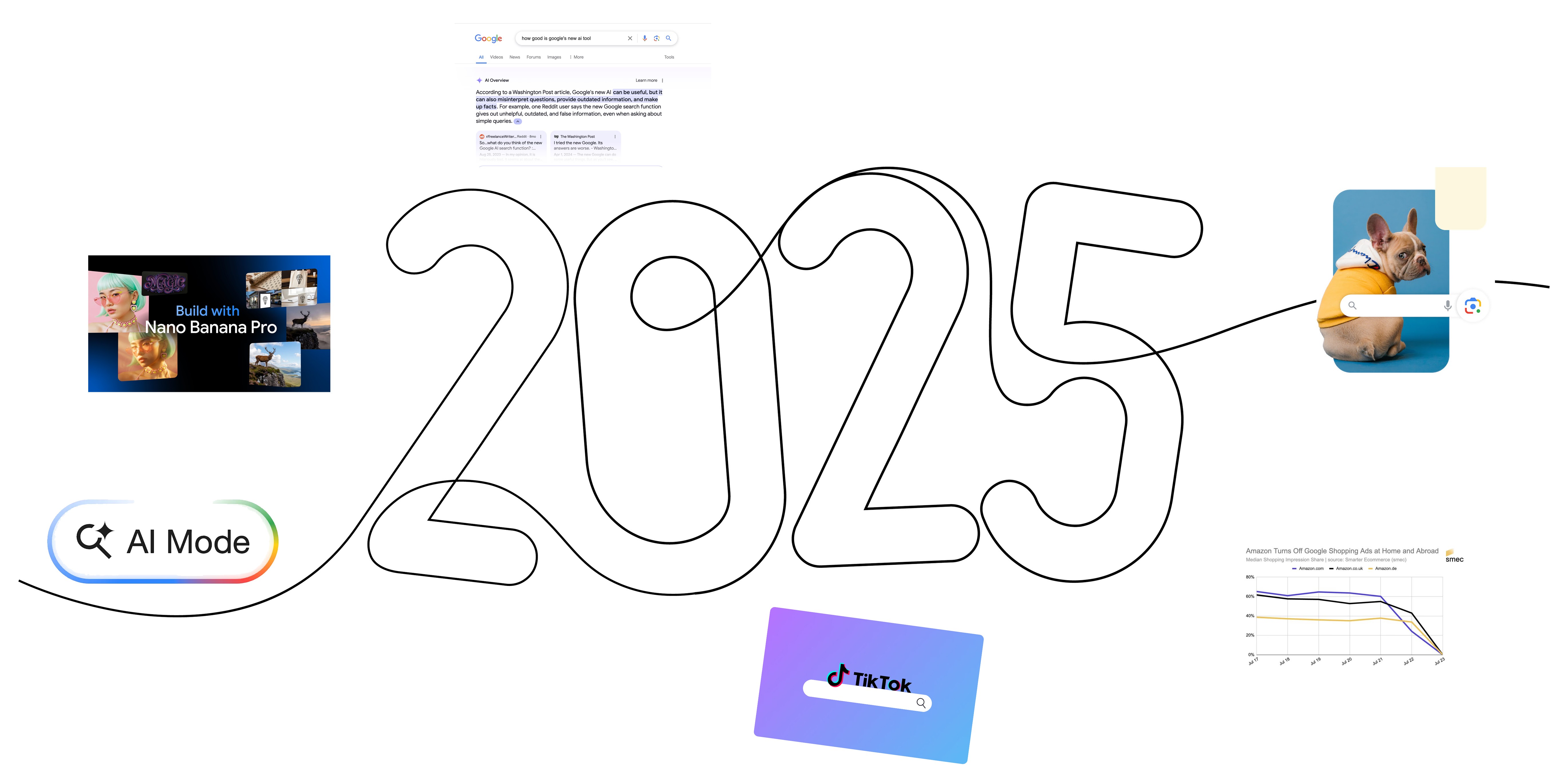
The year 2025 has been, quite frankly, a whirlwind. If you thought 2024 was fast-paced, the last 12 months have completely rewritten the rulebook. We have moved from an era of "searching for information" to one of "receiving intelligence", and for brands, the shift has been monumental.

At Clicky, we have been keeping a close eye on every update, algorithm shift, and platform pivot. From the Property & Home sector to retail giants, everyone has had to pivot hard. As we look towards 2026, here is our roundup of the 10 biggest things that happened in digital marketing this year.

1. Google Search became an "Intelligence Engine"

The launch of AI Mode and Gemini 3 fundamentally changed how we interact with Google. It is no longer just about typing keywords into a box; it is about conversation and reasoning. We saw Google roll out "Search Live" and agent-like capabilities that allow users to ask complex, layered questions. For marketers, this meant that "being the answer" became infinitely more important than just ranking for a term. If your content isn't structured for machine readability, you are essentially invisible in this new ecosystem.

2. Visual Search grew by 70%

We have been saying it for years, but 2025 was the year visual search truly exploded. With the updates to Google Lens in AI Mode, users are now searching with their cameras more than ever—uploading photos of rooms, outfits, or broken appliances to get instant solutions. In India alone, Lens usage overtook text search for certain demographics, a trend we are seeing ripple across the UK. If your images aren't optimised with the same rigour as your text, you are missing a massive slice of traffic.

3. Amazon pulled out of Google Shopping

In what was perhaps the biggest industry shock of the summer, Amazon pulled 100% of its Google Shopping ads in the US, UK, and Germany in mid-July. Whether this was a negotiation tactic or a permanent strategic shift, it sent ripples through the retail sector. For smaller retailers, this initially looked like an opportunity for cheaper clicks, but smart bidding models quickly adjusted. It was a stark reminder that relying on a single giant for visibility is a risky game.

4. Nano Banana Pro changed the creative workflow

We couldn't write this list without mentioning the curiously named Nano Banana Pro. Built on Gemini 3 Pro, this tool became a heavyweight for creative teams, particularly in the property sector. It allowed us to localise imagery instantly—changing a sunny Manchester skyline to a winter scene or translating shopfront signs in the background of a lifestyle shot—without a reshoot. It is tools like this that have slashed production costs and allowed for hyper-relevant creative at scale.

5. Meta retired Messenger Inbox Ads

As of November 11, 2025, the Messenger Inbox ad placement is officially history. Meta decided to streamline their inventory, removing this placement to focus on high-engagement areas like Reels and Feed. If you were running campaigns heavily reliant on direct message placements, you likely saw your budget automatically redistributed. It is a good move for user experience, but it forced many brands to rethink their "chat-first" acquisition strategies.

6. Zero-click searches hit new highs

Data suggests that zero-click searches—where a user gets their answer without ever visiting a website—climbed to nearly 69% in some sectors this year. With AI Overviews dominating the top of the SERP, users are getting direct answers immediately. This has forced a pivot in SEO strategy: we are no longer just optimising for clicks; we are optimising for brand visibility and reputation. If Google gives the answer, you want it to cite you as the source.

7. TikTok cemented itself as a Search Engine

For the "Gen Z" and "Alpha" demographics, TikTok is now the primary search engine. They aren't Googling "best cafes in Leeds"; they are searching it on TikTok to see the vibe, the food, and the crowd in video format. For our clients in the home and lifestyle space, this meant shifting video budgets from polished, TV-style ads to raw, authentic, "day-in-the-life" content that answers specific user queries.

8. Meta and GA4 finally synced up

After years of messy spreadsheets and third-party connectors, Meta finally introduced direct integration with Google Analytics 4 (GA4) to import ad cost data. This was a massive win for attribution. We can now see a clearer picture of Return on Ad Spend (ROAS) without the headache of manual uploads. It sounds technical, but for data-driven marketers, this was arguably the most practical update of the year.

9. The end of "Detailed Targeting"

Meta continued its push towards AI-driven automation by consolidating interest categories and removing "detailed targeting exclusions" in early 2025. Niche targeting options (like specific car models or obscure hobbies) vanished, replaced by broad categories. Advertisers who refused to trust the "Advantage+" algorithm saw their costs rise, while those who embraced broad targeting and let the AI find the customers flourished. The lesson? Trust the machine, but verify the creative.

10. Sustainability became a conversion metric

Finally, we saw a distinct shift in consumer behaviour regarding sustainability, especially in the property market. "Energy Transparency" became more than just a regulatory requirement; it became a conversion factor. Buyers and renters are now actively filtering for energy efficiency. Brands that highlighted green credentials upfront—rather than burying them in the small print—saw better engagement rates.

Ready for 2026?

If 2025 taught us anything, it is that standing still is the fastest way to move backwards. The digital landscape is smarter, faster, and more visual than ever before.

If you want to ensure your brand is ready for what comes next, our Innovation Team is already testing the tools of tomorrow. Get in touch with us today.

At Clicky, we have been keeping a close eye on every update, algorithm shift, and platform pivot. From the Property & Home sector to retail giants, everyone has had to pivot hard. As we look towards 2026, here is our roundup of the 10 biggest things that happened in digital marketing this year.

1. Google Search became an "Intelligence Engine"

The launch of AI Mode and Gemini 3 fundamentally changed how we interact with Google. It is no longer just about typing keywords into a box; it is about conversation and reasoning. We saw Google roll out "Search Live" and agent-like capabilities that allow users to ask complex, layered questions. For marketers, this meant that "being the answer" became infinitely more important than just ranking for a term. If your content isn't structured for machine readability, you are essentially invisible in this new ecosystem.

2. Visual Search grew by 70%

We have been saying it for years, but 2025 was the year visual search truly exploded. With the updates to Google Lens in AI Mode, users are now searching with their cameras more than ever—uploading photos of rooms, outfits, or broken appliances to get instant solutions. In India alone, Lens usage overtook text search for certain demographics, a trend we are seeing ripple across the UK. If your images aren't optimised with the same rigour as your text, you are missing a massive slice of traffic.

3. Amazon pulled out of Google Shopping

In what was perhaps the biggest industry shock of the summer, Amazon pulled 100% of its Google Shopping ads in the US, UK, and Germany in mid-July. Whether this was a negotiation tactic or a permanent strategic shift, it sent ripples through the retail sector. For smaller retailers, this initially looked like an opportunity for cheaper clicks, but smart bidding models quickly adjusted. It was a stark reminder that relying on a single giant for visibility is a risky game.

4. Nano Banana Pro changed the creative workflow

We couldn't write this list without mentioning the curiously named Nano Banana Pro. Built on Gemini 3 Pro, this tool became a heavyweight for creative teams, particularly in the property sector. It allowed us to localise imagery instantly—changing a sunny Manchester skyline to a winter scene or translating shopfront signs in the background of a lifestyle shot—without a reshoot. It is tools like this that have slashed production costs and allowed for hyper-relevant creative at scale.

5. Meta retired Messenger Inbox Ads

As of November 11, 2025, the Messenger Inbox ad placement is officially history. Meta decided to streamline their inventory, removing this placement to focus on high-engagement areas like Reels and Feed. If you were running campaigns heavily reliant on direct message placements, you likely saw your budget automatically redistributed. It is a good move for user experience, but it forced many brands to rethink their "chat-first" acquisition strategies.

6. Zero-click searches hit new highs

Data suggests that zero-click searches—where a user gets their answer without ever visiting a website—climbed to nearly 69% in some sectors this year. With AI Overviews dominating the top of the SERP, users are getting direct answers immediately. This has forced a pivot in SEO strategy: we are no longer just optimising for clicks; we are optimising for brand visibility and reputation. If Google gives the answer, you want it to cite you as the source.

7. TikTok cemented itself as a Search Engine

For the "Gen Z" and "Alpha" demographics, TikTok is now the primary search engine. They aren't Googling "best cafes in Leeds"; they are searching it on TikTok to see the vibe, the food, and the crowd in video format. For our clients in the home and lifestyle space, this meant shifting video budgets from polished, TV-style ads to raw, authentic, "day-in-the-life" content that answers specific user queries.

8. Meta and GA4 finally synced up

After years of messy spreadsheets and third-party connectors, Meta finally introduced direct integration with Google Analytics 4 (GA4) to import ad cost data. This was a massive win for attribution. We can now see a clearer picture of Return on Ad Spend (ROAS) without the headache of manual uploads. It sounds technical, but for data-driven marketers, this was arguably the most practical update of the year.

9. The end of "Detailed Targeting"

Meta continued its push towards AI-driven automation by consolidating interest categories and removing "detailed targeting exclusions" in early 2025. Niche targeting options (like specific car models or obscure hobbies) vanished, replaced by broad categories. Advertisers who refused to trust the "Advantage+" algorithm saw their costs rise, while those who embraced broad targeting and let the AI find the customers flourished. The lesson? Trust the machine, but verify the creative.

10. Sustainability became a conversion metric

Finally, we saw a distinct shift in consumer behaviour regarding sustainability, especially in the property market. "Energy Transparency" became more than just a regulatory requirement; it became a conversion factor. Buyers and renters are now actively filtering for energy efficiency. Brands that highlighted green credentials upfront—rather than burying them in the small print—saw better engagement rates.

Ready for 2026?

If 2025 taught us anything, it is that standing still is the fastest way to move backwards. The digital landscape is smarter, faster, and more visual than ever before.

If you want to ensure your brand is ready for what comes next, our Innovation Team is already testing the tools of tomorrow. Get in touch with us today.

more BLogs

more BLogs