Wednesday, December 10, 2025 / Clicky News

2025 Google Ads Wrapped : A look back at what changed

2025 Google Ads Wrapped : A look back at what changed

From the launch of entirely new campaign types to the creative revolution powered by advanced models, Google Ads has undergone a massive transformation over the last twelve months.
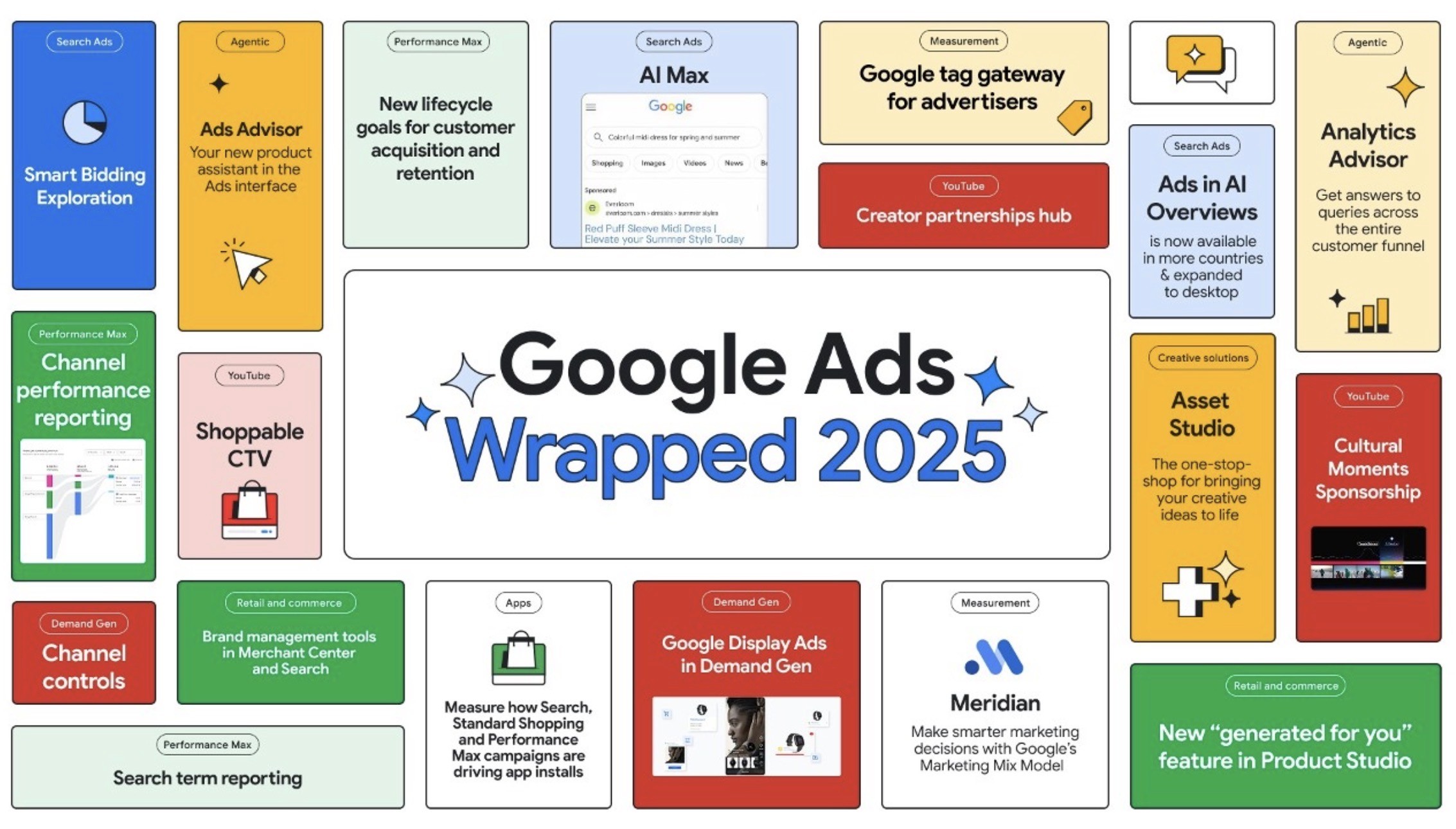
From the launch of entirely new campaign types to the creative revolution powered by advanced models, Google Ads has undergone a massive transformation over the last twelve months.

Matt Jones

Matt Jones

PPC Team Lead

PPC Team Lead

For marketers, it has been a year of adaptation. We have had to learn to trust the machine more than ever, while simultaneously mastering the new controls given to us to steer it. If you are looking to catch up on what happened or simply want a refresher on the tools now at your disposal, here is our round-up of what was new in Google Ads this year.

Performance Max Got a Major Upgrade

Performance Max (PMax) continued its dominance in 2025, but the biggest news was that Google finally gave advertisers the control they had been asking for. After years of feeling like a "black box," PMax became far more transparent and manageable.

This year saw the rollout of campaign-level negative keywords, allowing us to exclude up to 10,000 specific terms. This was a game-changer for brand safety and budget efficiency, ensuring ads did not appear against irrelevant queries.

We also saw the limit for Search Themes double from 25 to 50, giving the AI significantly more data to find your ideal customers. on top of that, new device targeting controls meant we could finally adjust bids or exclude mobile, desktop, or tablet traffic specifically within PMax campaigns.

The Arrival of AI Max

Just when we were getting comfortable with PMax, Google introduced AI Max for Search. Currently rolling out globally, this new campaign type represents the next evolution of search advertising.

AI Max is designed to go beyond traditional keywords entirely. It uses advanced language understanding to match ads to user intent rather than just search terms. While it sounded daunting at first, early results suggest it is incredibly effective for capturing mid-funnel traffic that standard keyword campaigns often miss. It essentially bridges the gap between discovery and decision, using dynamic assets to answer complex user queries.

A Creative Revolution with Nano Banana Pro

Creativity took centre stage in 2025. The days of struggling to produce enough assets for every format are fading fast, thanks to the integration of Nano Banana Pro into Google's Asset Studio.

This new model allows advertisers to generate photorealistic lifestyle imagery and product showcases in seconds. You can now take a simple product shot and prompt the AI to place it in a seasonal setting or a specific lifestyle scene with startling accuracy. Along with Veo 3.1 for video generation, these tools have made it easier than ever to fill the diverse asset requirements of Demand Gen and PMax campaigns without blowing the creative budget.

Demand Gen Replaced Video Action

In a significant consolidation move mid-year, Google transitioned Video Action Campaigns (VAC) into Demand Gen campaigns. This shift signalled a move towards more visual, immersive storytelling.

Demand Gen has expanded its reach significantly, now serving ads across YouTube (including Shorts), Discover, and Gmail from a single campaign. The addition of accelerated checkout features for Demand Gen in the UK and US also helped shorten the path to purchase, allowing users to buy directly from an ad with fewer clicks.

Measurement and Data Privacy

With the third-party cookie phase-out finally hitting its stride in 2025, first-party data became the gold standard. To help with this, Google launched the Data Manager API, simplifying the process of connecting your first-party data sources directly to Google Ads.

We also saw the introduction of Meridian, an open-source Marketing Mix Model (MMM). Meridian helps advertisers measure the impact of their marketing across all channels—not just Google's—giving a much truer picture of ROI in a privacy-centric world.

Summary

2025 was undeniably the year of AI maturity in Google Ads. We moved past the initial hype and into practical, performance-driving applications. The platform is now more automated than ever, but with the new controls released this year, savvy marketers have more power to direct that automation than they did twelve months ago.

As we look towards 2026, the key will be continuing to feed these systems with high-quality data and creative assets. If this year was any indication, the tools will only get sharper, and the brands that learn to use them effectively will be the ones that win.

For marketers, it has been a year of adaptation. We have had to learn to trust the machine more than ever, while simultaneously mastering the new controls given to us to steer it. If you are looking to catch up on what happened or simply want a refresher on the tools now at your disposal, here is our round-up of what was new in Google Ads this year.

Performance Max Got a Major Upgrade

Performance Max (PMax) continued its dominance in 2025, but the biggest news was that Google finally gave advertisers the control they had been asking for. After years of feeling like a "black box," PMax became far more transparent and manageable.

This year saw the rollout of campaign-level negative keywords, allowing us to exclude up to 10,000 specific terms. This was a game-changer for brand safety and budget efficiency, ensuring ads did not appear against irrelevant queries.

We also saw the limit for Search Themes double from 25 to 50, giving the AI significantly more data to find your ideal customers. on top of that, new device targeting controls meant we could finally adjust bids or exclude mobile, desktop, or tablet traffic specifically within PMax campaigns.

The Arrival of AI Max

Just when we were getting comfortable with PMax, Google introduced AI Max for Search. Currently rolling out globally, this new campaign type represents the next evolution of search advertising.

AI Max is designed to go beyond traditional keywords entirely. It uses advanced language understanding to match ads to user intent rather than just search terms. While it sounded daunting at first, early results suggest it is incredibly effective for capturing mid-funnel traffic that standard keyword campaigns often miss. It essentially bridges the gap between discovery and decision, using dynamic assets to answer complex user queries.

A Creative Revolution with Nano Banana Pro

Creativity took centre stage in 2025. The days of struggling to produce enough assets for every format are fading fast, thanks to the integration of Nano Banana Pro into Google's Asset Studio.

This new model allows advertisers to generate photorealistic lifestyle imagery and product showcases in seconds. You can now take a simple product shot and prompt the AI to place it in a seasonal setting or a specific lifestyle scene with startling accuracy. Along with Veo 3.1 for video generation, these tools have made it easier than ever to fill the diverse asset requirements of Demand Gen and PMax campaigns without blowing the creative budget.

Demand Gen Replaced Video Action

In a significant consolidation move mid-year, Google transitioned Video Action Campaigns (VAC) into Demand Gen campaigns. This shift signalled a move towards more visual, immersive storytelling.

Demand Gen has expanded its reach significantly, now serving ads across YouTube (including Shorts), Discover, and Gmail from a single campaign. The addition of accelerated checkout features for Demand Gen in the UK and US also helped shorten the path to purchase, allowing users to buy directly from an ad with fewer clicks.

Measurement and Data Privacy

With the third-party cookie phase-out finally hitting its stride in 2025, first-party data became the gold standard. To help with this, Google launched the Data Manager API, simplifying the process of connecting your first-party data sources directly to Google Ads.

We also saw the introduction of Meridian, an open-source Marketing Mix Model (MMM). Meridian helps advertisers measure the impact of their marketing across all channels—not just Google's—giving a much truer picture of ROI in a privacy-centric world.

Summary

2025 was undeniably the year of AI maturity in Google Ads. We moved past the initial hype and into practical, performance-driving applications. The platform is now more automated than ever, but with the new controls released this year, savvy marketers have more power to direct that automation than they did twelve months ago.

As we look towards 2026, the key will be continuing to feed these systems with high-quality data and creative assets. If this year was any indication, the tools will only get sharper, and the brands that learn to use them effectively will be the ones that win.

more BLogs

more BLogs