Bing give us all a AI Performance Report : Come on Google you next!

Bing give us all a AI Performance Report : Come on Google you next!

Thursday, February 12, 2026

Microsoft has officially launched an AI Performance report within Bing Webmaster Tools. This new dashboard reveals exactly how often your content is cited in AI-generated answers and, crucially, which specific 'grounding queries' triggered those citations. Come on Google, keep up.
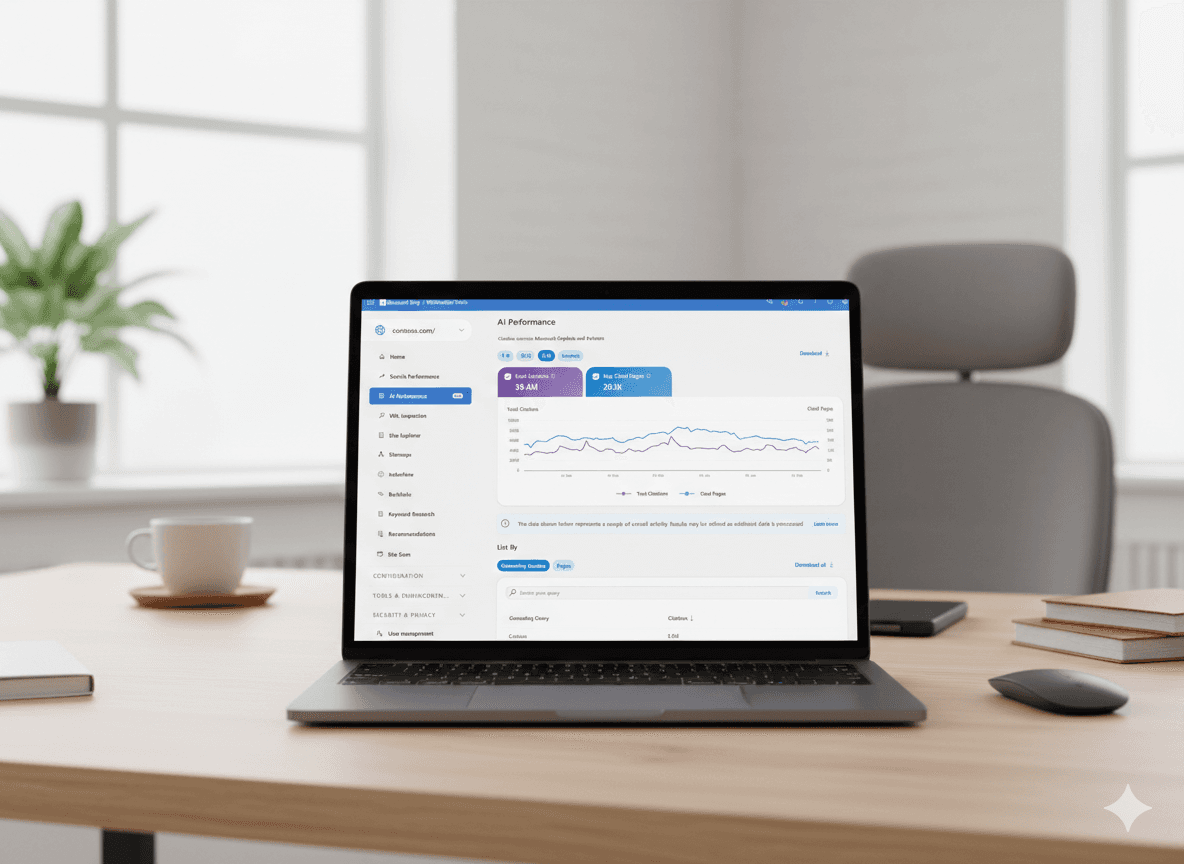
Microsoft has officially launched an AI Performance report within Bing Webmaster Tools. This new dashboard reveals exactly how often your content is cited in AI-generated answers and, crucially, which specific 'grounding queries' triggered those citations. Come on Google, keep up.

Michael Scott

Michael Scott

Head of Organic

Head of Organic

For digital marketers and site owners, the rise of generative AI in search has been a double-edged sword. We know our content is being used to train models and generate answers, but for the most part, we have been flying blind regarding the specifics.

That changed recently with the launch of the AI Performance report in Bing Webmaster Tools. This new dashboard is not just a minor update; it is the first time a major search engine has given us a dedicated view into how our content grounds AI-generated responses.

The metrics we have been waiting for

The new report moves beyond standard 'impressions' and 'clicks' to measure the specific interactions unique to AI search. As detailed by Search Engine Journal, the dashboard breaks down performance into several critical data points:

  • Total Citations: This metric tracks the volume of times your content is cited as a source in an AI-generated answer. It is a direct measure of authority within the model.

  • Grounding Queries: Unlike standard search queries, these are the specific phrases or questions that caused the AI to 'look up' your content to formulate an answer.

  • Page-Level Attribution: You can finally see which individual URLs are doing the heavy lifting. This allows you to identify exactly which pieces of content the AI finds most trustworthy.

This level of granularity is a game-changer. It allows us to move from guessing which content is 'AI-friendly' to knowing exactly which pages are winning citations and for what topics.

The silence from Google

While Microsoft is opening the door, Google remains surprisingly opaque. Currently, Google Search Console aggregates AI Overview data with standard organic search metrics. As noted in recent industry discussions, there is no simple way to filter performance reports to isolate AI-driven traffic or impressions.

This 'black box' approach is becoming increasingly untenable. With AI Overviews appearing for a significant percentage of queries, site owners deserve to know whether their drop in organic traffic is due to a loss of rankings or simply because users are getting their answer directly from an AI summary that cites them.

Why transparency is essential

The industry is shifting from 'Search Engine Optimisation' to 'Generative Engine Optimisation'. In this new landscape, a 'citation' is the new 'ranking'.

Without clear data from Google, publishers are left in a precarious position. We are effectively being asked to trust that our content is being valued, without the metrics to prove it. As The Media Leader points out, this presents an existential challenge for publishers who rely on referral traffic.

If Google wants to maintain a healthy ecosystem of content creators, it must provide the same level of insight that Bing has now normalised. We need to differentiate between a user who scrolled past our link and a user who read a summary derived from our hard work.

What you can do right now

We cannot force Google’s hand, but we can use the data available to us. The insights from Bing’s AI Performance report are likely transferable. If a specific page is winning citations in Copilot, it is highly probable that it has the right structure and information density for Gemini as well.

We recommend auditing your Bing data immediately to identify your winning 'grounding queries'. You can then double down on that content strategy across your site.

For digital marketers and site owners, the rise of generative AI in search has been a double-edged sword. We know our content is being used to train models and generate answers, but for the most part, we have been flying blind regarding the specifics.

That changed recently with the launch of the AI Performance report in Bing Webmaster Tools. This new dashboard is not just a minor update; it is the first time a major search engine has given us a dedicated view into how our content grounds AI-generated responses.

The metrics we have been waiting for

The new report moves beyond standard 'impressions' and 'clicks' to measure the specific interactions unique to AI search. As detailed by Search Engine Journal, the dashboard breaks down performance into several critical data points:

  • Total Citations: This metric tracks the volume of times your content is cited as a source in an AI-generated answer. It is a direct measure of authority within the model.

  • Grounding Queries: Unlike standard search queries, these are the specific phrases or questions that caused the AI to 'look up' your content to formulate an answer.

  • Page-Level Attribution: You can finally see which individual URLs are doing the heavy lifting. This allows you to identify exactly which pieces of content the AI finds most trustworthy.

This level of granularity is a game-changer. It allows us to move from guessing which content is 'AI-friendly' to knowing exactly which pages are winning citations and for what topics.

The silence from Google

While Microsoft is opening the door, Google remains surprisingly opaque. Currently, Google Search Console aggregates AI Overview data with standard organic search metrics. As noted in recent industry discussions, there is no simple way to filter performance reports to isolate AI-driven traffic or impressions.

This 'black box' approach is becoming increasingly untenable. With AI Overviews appearing for a significant percentage of queries, site owners deserve to know whether their drop in organic traffic is due to a loss of rankings or simply because users are getting their answer directly from an AI summary that cites them.

Why transparency is essential

The industry is shifting from 'Search Engine Optimisation' to 'Generative Engine Optimisation'. In this new landscape, a 'citation' is the new 'ranking'.

Without clear data from Google, publishers are left in a precarious position. We are effectively being asked to trust that our content is being valued, without the metrics to prove it. As The Media Leader points out, this presents an existential challenge for publishers who rely on referral traffic.

If Google wants to maintain a healthy ecosystem of content creators, it must provide the same level of insight that Bing has now normalised. We need to differentiate between a user who scrolled past our link and a user who read a summary derived from our hard work.

What you can do right now

We cannot force Google’s hand, but we can use the data available to us. The insights from Bing’s AI Performance report are likely transferable. If a specific page is winning citations in Copilot, it is highly probable that it has the right structure and information density for Gemini as well.

We recommend auditing your Bing data immediately to identify your winning 'grounding queries'. You can then double down on that content strategy across your site.

more BLogs

more BLogs