Friday, December 19, 2025

ChatGTP Images vs Nano Banana Pro

ChatGTP Images vs Nano Banana Pro

ChatGPT just upgraded their Ai image creation tool. We compare how the same JSON prompts is interpreted by each.
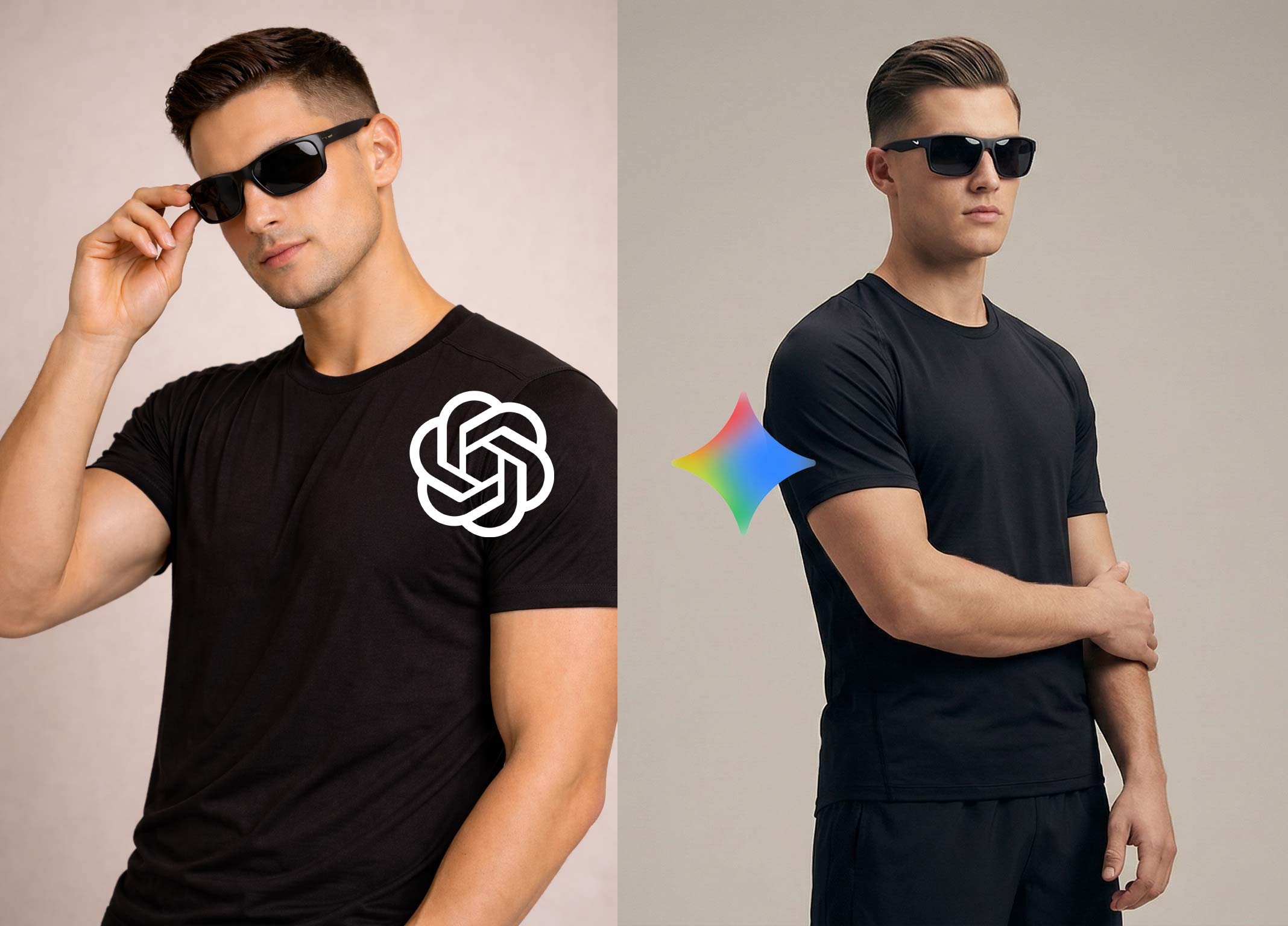
ChatGPT just upgraded their Ai image creation tool. We compare how the same JSON prompts is interpreted by each.

Oli Yeates

Oli Yeates

CEO & Founder

CEO & Founder

So here is the prompt:

{ "scene": "Studio photoshoot, soft warm grey seamless background, minimal editorial", "subject": "Male model standing, arms in shot, sleek haircut, black gym wear", "product": "Nike sunglasses, visible logo, black model", "tech": "Soft studio lighting, 50mm f/2.8, 8k ultra photorealistic, shallow depth of field", "negative": "color mismatch, distorted anatomy, cartoon, low res" }

And here is the output first from Google Nano Banana Pro:

And now we try the same prompt with ChatGPT Images:

They are both pretty impressive but I think Nano Banana is slightly better and more realistic.

The digital marketing landscape has shifted, and Google’s Nano Banana Pro has firmly established itself as the superior choice for precision, leaving ChatGPT Images to serve primarily as a quick concepting tool. While OpenAI’s latest update offers impressive speed for rapid ideation, it simply cannot compete with the granular control provided by the Nano Banana ‘Thinking’ model. For professionals who require exactitude over volume, Google’s architecture is now the industry standard for high-fidelity output.

This accuracy gap becomes undeniable when handling complex commercial assets. By supporting up to 14 reference images, Nano Banana Pro allows us to lock in brand guidelines and character consistency with a reliability that ChatGPT struggles to replicate. When you combine this with its ability to render legible, mistake-free text and a physics-aware reasoning engine that understands real-world object relationships, Nano Banana Pro stands out as the only viable option for polished, client-ready deliverables.

So here is the prompt:

{ "scene": "Studio photoshoot, soft warm grey seamless background, minimal editorial", "subject": "Male model standing, arms in shot, sleek haircut, black gym wear", "product": "Nike sunglasses, visible logo, black model", "tech": "Soft studio lighting, 50mm f/2.8, 8k ultra photorealistic, shallow depth of field", "negative": "color mismatch, distorted anatomy, cartoon, low res" }

And here is the output first from Google Nano Banana Pro:

And now we try the same prompt with ChatGPT Images:

They are both pretty impressive but I think Nano Banana is slightly better and more realistic.

The digital marketing landscape has shifted, and Google’s Nano Banana Pro has firmly established itself as the superior choice for precision, leaving ChatGPT Images to serve primarily as a quick concepting tool. While OpenAI’s latest update offers impressive speed for rapid ideation, it simply cannot compete with the granular control provided by the Nano Banana ‘Thinking’ model. For professionals who require exactitude over volume, Google’s architecture is now the industry standard for high-fidelity output.

This accuracy gap becomes undeniable when handling complex commercial assets. By supporting up to 14 reference images, Nano Banana Pro allows us to lock in brand guidelines and character consistency with a reliability that ChatGPT struggles to replicate. When you combine this with its ability to render legible, mistake-free text and a physics-aware reasoning engine that understands real-world object relationships, Nano Banana Pro stands out as the only viable option for polished, client-ready deliverables.

more BLogs

more BLogs