Michael Scott · 6 July 2026
England v Mexico in Google Trends: The Nation Stayed Up Till 4am, Then Woke Up and Googled It
We pulled Google Trends for the whole of England v Mexico and the morning after, and you can see two nations in one line: the diehards who stayed up for the 2am kick-off and peaked at 4am as ten men held on, and the larger crowd who woke up and Googled the result. Here is the real search data behind the delayed kick-off, the goals, the red card and the final whistle.
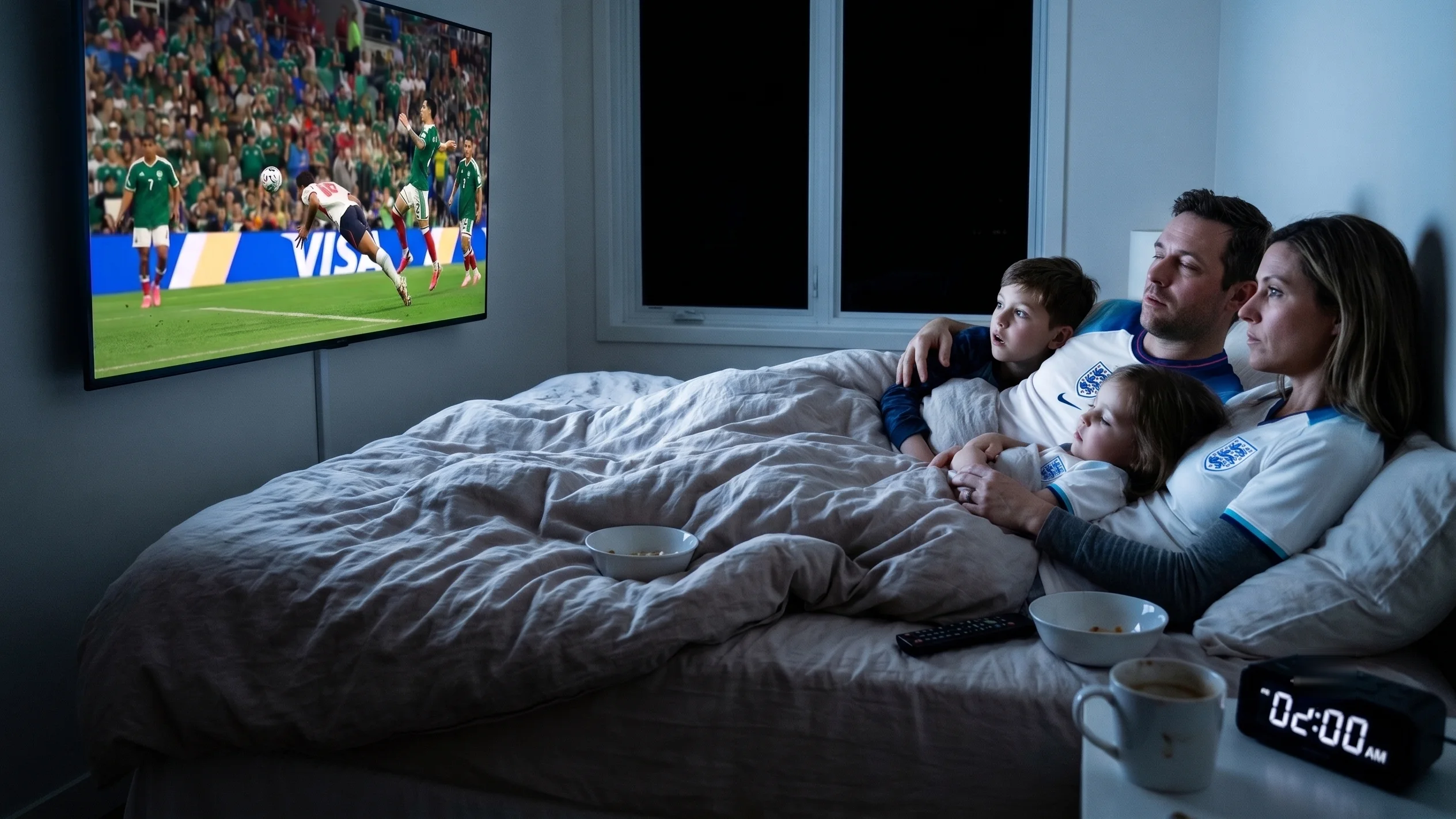
Two Englands watched this football match. There was the one that stayed up: bleary, brave, propped against the kitchen counter at two in the morning on a work night, watching Jude Bellingham score twice in ninety-eight seconds and then chewing every fingernail off as ten men clung on. And there was the other England, the sensible one, that went to bed, woke up, reached for its phone before its eyes were properly open, and Googled what on earth it had missed.
We can see both of them. Not guess at them, see them, hour by hour, in the search data. So being the data lot we are, we pulled Google Trends for the whole of match night and the morning after. It is the closest thing we have to a live heart-rate monitor for the national mood, and this one has two heartbeats: the people who lived it, and the people who caught up on it.
The nation that stayed up, and the one that woke up
Here is the whole thing on one line. Interest in "England" ticked along near nothing all Sunday, lifted around midnight as people worked out whether they could really do this, climbed through the delayed kick off, and then went vertical. It hit its absolute ceiling, a flat 100, at around 4am, right as England were hanging on with ten men and the whistle went. That is the stayed-up nation, all refreshing at once in the dead of night.
And then look at what happens next. The line does not fall off a cliff the way you would expect at 4am. It eases down and stays high, holding at half its peak or better all the way through breakfast, because a second, larger and better-rested England was waking up and searching for the result. Same event, two completely different audiences, and you can watch the baton pass from one to the other at first light.
How big was the stayed-up half? We will not pretend to a number nobody has published yet. The official overnight audience for a 4am finish takes a while to land, and we do not guess numbers. But here is the context. England's tea-time win over DR Congo five days earlier drew a peak of 16.3 million on the BBC, the broadcaster's biggest live audience of the year. The all-time record for any British television after midnight is 18.5 million, set by the 1985 snooker final and unbeaten in forty years. This kicked off at 2am on a Monday, with the pubs licensed until 5am to keep people out of their own living rooms. Whatever the final figure, a country that turns out in those numbers at that hour is telling you something.
First, nobody was sure what time it started
Before a ball was kicked, the biggest search story was not the team news. It was the clock. This tie was a logistical soap opera. In the days beforehand there were reports the Mexican government wanted the kick off brought forward by a full six hours, to noon local time, over fears of afternoon storms. The Mexican federation and the FA both pushed back, FIFA held the slot, and then on the night the weather had the final word anyway: lightning within eight miles of the Azteca forced a delay, the countdown clock resetting with every strike, and an already brutal 1am British kick off slid back to gone 2am.
The country had no idea what was going on, and it did what it always does when confused. It Googled. The rising searches around this match were not led by the players. They were led by people simply trying to find out when, and whether, the thing was on. "England game moved." "What time is england vs mexico." "Mexico vs england time." Every one of them a breakout. Even "daylight saving time" as a topic jumped 2,800 per cent, a whole nation doing the time-zone maths at once.
You can watch the goals go in, and the red card too
Now index the key players against each other and the search graph turns into the match report. Each man spikes around his own moment. Bellingham goes vertical first and highest, exactly when he headed the two goals that decided it inside two first-half minutes. Jarell Quansah, a name most casual fans could not have picked out an hour earlier, erupts from almost nothing the instant he is sent off by VAR: the classic "who is this person" search. Harry Kane climbs on his penalty. And Jordan Pickford peaks last of all, later than everyone, right as ten-man England dug in and he kept them alive to the final whistle.
This is the point we make to clients until we are blue in the face. Search behaviour is not a monthly report you read three weeks late. It is a live signal. When something happens in your category, and a red card is about as sudden as it gets, the demand shows up in the data inside the minute. If you are watching, you can move with it instead of after it.
And when they search, they search for people
Here is the layer underneath all of it. Look at the size of the audience each name commands in a normal month, long before kick off. "World cup 2026" is the biggest single term, on 246,000 searches a month in the UK. But then look at the players stacked up behind it: Bellingham, Kane, Rashford and Rice all on 135,000 apiece. Four individual footballers, each pulling more than half the entire tournament's search demand on their own. The badge matters. The people matter more.
And do not miss Jarell Quansah at the bottom, on a modest 12,100 a month. That is the whole opportunity in one bar. A low, quiet baseline, and then a night like this sends it through the roof for a few hours. The debutants and the fringe names off a small base are exactly who the casual fan goes looking for after a big moment, the search jumps hardest in percentage terms, and it happens overnight and fades just as fast. If you are a brand, that is the wave you want to be ready to catch, not the one you read about next month.
Two heartbeats, one signal
For one long night and the bleary morning after it, you could see the whole country in the numbers: the diehards who stayed up and lived every minute, and the sensible majority who woke, reached for a phone, and caught up in a scroll. The trends measure the moment. The moment itself is pure emotion. The job, ours and yours, is reading both at once, and being ready to move the second the nation does. We will keep watching the figures. Tuchel's lot can keep winning the games. Come on England.