Nathan Smith · 20 May 2026
Google I/O 2026: our honest take on every big announcement
Google I/O 2026 was the Gemini show from start to finish: agents everywhere, the answer becoming the destination, and the click economy squeezed again. As a Google Premier Partner we go through every major announcement, feature by feature, with our honest take: what's genuinely useful, what's polish dressed up as revolution, and what should make every marketer sit up.
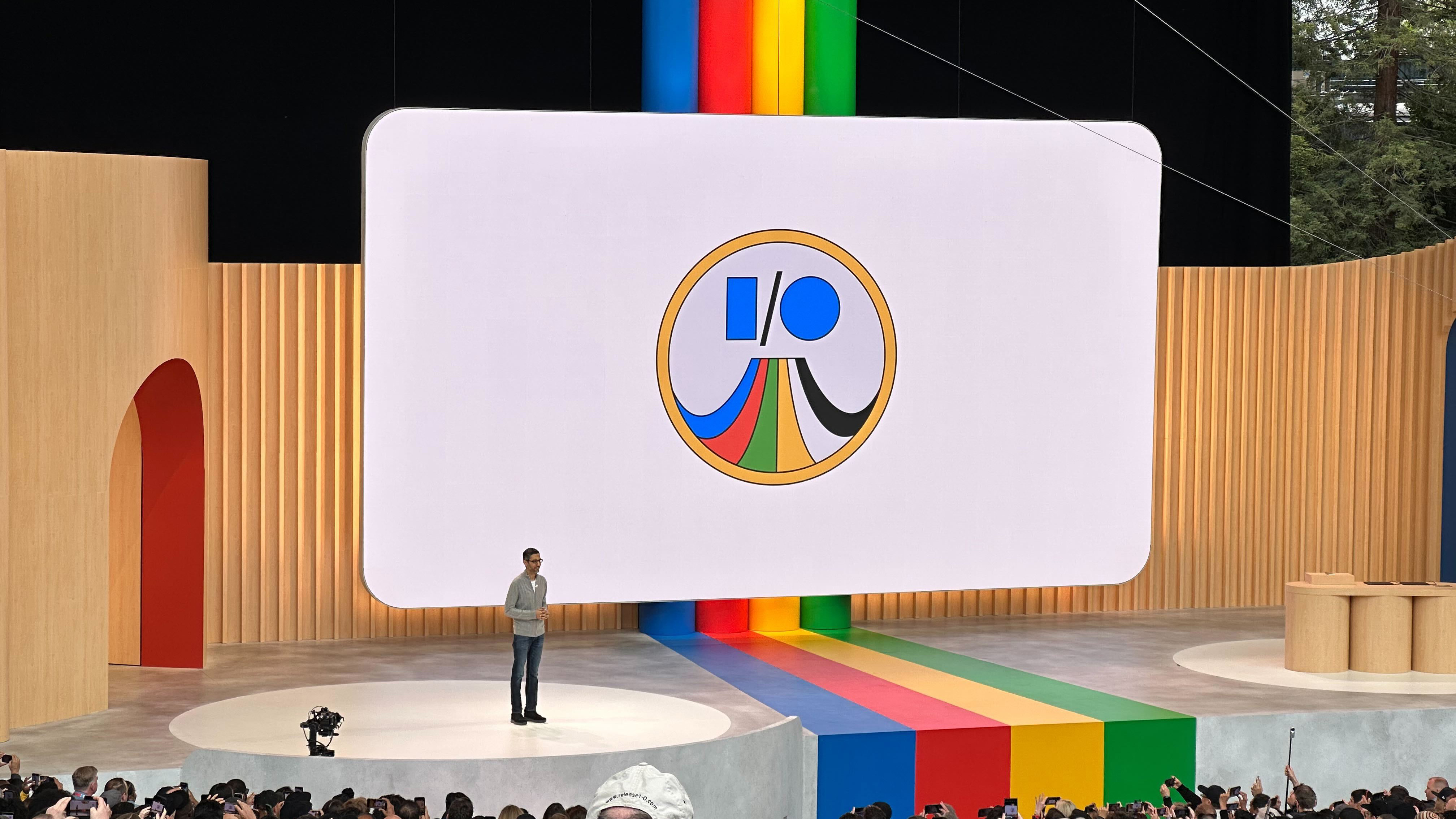
Google I/O 2026 has been and gone, and the headline is hard to miss: Gemini is now the whole show. Where previous keynotes spread the love across Android, Chrome, Workspace and a dozen hardware bets, this year almost everything led back to one model family and one idea: agents that do things for you, quietly, in the background, without you ever leaving Google. As a Google Premier Partner we watched the whole thing, and rather than just cheering along, we want to give you our honest read: what is genuinely useful, what is polish dressed up as a revolution, and what should make every marketer sit up.
Here is our take on each major announcement, feature by feature.
Gemini Omni: text, image and audio in, finished video out
Omni takes any mix of inputs (a photo, a voice note, a rough script, a clip) and produces a polished video you can then refine just by talking to it. It launches first as Gemini Omni Flash for paid subscribers through the Gemini app and Google Flow, and free for YouTube Shorts and Create users.

Our take: This is the announcement with the most immediate commercial pull. The leap from "prompt to clip" to "conversational editing" is the bit that matters: being able to say "make the opening punchier, drop the music under the voiceover" is how real creative teams actually work. For social-first brands the production maths changes overnight. But two cautions. First, putting it free into Shorts means your beautifully crafted ad now competes in a feed flooded with the same tool's output, the bar for ideas goes up, not down. Second, this is exactly the content that makes provenance and watermarking (more on SynthID below) non-negotiable. Powerful, genuinely useful, and the one we will be testing for clients first.
Gemini 3.5 Flash: frontier performance at the cheap tier
The new Flash model is being positioned as frontier-level at complex reasoning, agents and coding, available across the API, Android Studio, Google Antigravity, AI Mode in Search and the enterprise platform. Gemini 3.5 Pro follows next month.

Our take: The interesting word is "Flash." When the cheap, fast model is good enough to power agents, the economics of automation shift for everyone: you can run far more of it for far less. That is what makes the rest of this keynote affordable to ship. The flip side is cadence fatigue: 3.5 Flash today, 3.5 Pro next month, and another number by autumn. For businesses the lesson is to build on capabilities and outcomes, not version numbers, because whatever you standardise on will be superseded before the contract renews.
Information Agents in Search: "keep me updated" as a standing instruction
Add "keep me updated" to a search and Google spins up an agent that reasons across the web around the clock and feeds you personalised updates. Rolling out summer 2026 for AI Pro and Ultra subscribers.

Our take: This is a quietly huge shift in how search works, and it should worry anyone who lives on organic traffic. A one-off query becomes a persistent relationship between the user and Google, not between the user and your site. The agent reads your content, synthesises it, and reports back inside Google. You may be the source and still never get the visit. It is the logical end-point of the trend we wrote about in the state of SEO in 2026: being cited matters as much as being ranked, because increasingly the citation is all the user sees.
Antigravity-powered Search experiences: Google builds the page for you
Search can now generate custom layouts, interactive visuals, dashboards and trackers on the fly for whatever you are researching. Free for everyone in summer 2026, with the ability to build your own custom experiences starting for Pro/Ultra users in the US.

Our take: Impressive technically, and another nail in the click economy. When Google can assemble a bespoke comparison table, planner or tracker from across the web, the user has even less reason to open the underlying sites. For publishers and comparison-led businesses this is the threat model made real: your content becomes raw material for an interface Google owns. The defensive play is to be the destination that offers something the generated layout cannot: depth, tools, community, genuine expertise. Thin, templated content is now competing directly with a machine that templates better and faster.
Daily Brief: a morning digest stitched from your Google life
A personalised morning summary in the Gemini app that pulls together Gmail, Calendar and relevant follow-ups, prioritised against your stated goals. Rolling out to US AI subscribers with connected Google apps.

Our take: Useful, unglamorous, and probably one of the stickiest features here precisely because it becomes a daily habit. The strategic point for marketers is the surface: if the first thing your customer reads each morning is a Google-curated brief, then your email, your offer and your update are being triaged by an agent before a human sees them. Deliverability and relevance stop being about the inbox and start being about whether the agent judges you worth surfacing. The honest caveat is reliability: these digests are only as good as their prioritisation, and "helpful" is one bad summary away from "ignored."
Universal Cart: Google as the checkout layer across the web
A cross-merchant shopping hub built into Search, Gemini, YouTube and Gmail that tracks deals, price drops, price history and stock across retailers. Rolling out summer 2026, US first.

Our take: This is the one with the biggest long-term consequences for retail clients, and it deserves real scrutiny. A universal cart abstracts the merchant away: the customer shops Google, not your storefront. You lose control of the experience, the upsell, the brand moment, and potentially the first-party data that the whole modern marketing stack depends on. We have seen this movie before with marketplaces, and the pattern is always the same: convenience for the shopper, commoditisation for the seller. Watch closely for whether Google takes a cut, as others have started to (OpenAI's checkout fee being the obvious comparison), and what data retailers actually get back. Brilliant for consumers; retailers should go in with eyes open about who owns the customer at the end of it.
Neural Expressive: the Gemini redesign
A reworked Gemini interface with fluid animation, bold colour, haptics, and answers that come back as rich objects: imagery, timelines, videos and dynamic graphics rather than walls of text. Rolling out now on Android, iOS and web.

Our take: On the surface this is a coat of paint, and a nice one. But the substance hiding inside the styling is that answers are becoming self-contained, visual and complete. The more Gemini can show rather than link, the less the underlying web gets clicked. So while the headline is "prettier chatbot," the marketing read is the same as everywhere else this year: the answer is the destination now. Plan your content to be the thing worth quoting inside that answer.
Gemini Spark: an always-on agent inside your Workspace
A 24/7 personal agent that handles tasks across Gmail, Docs and Slides, supports recurring jobs and custom workflows, and runs in the background. Out to trusted testers and as a beta for US AI Ultra subscribers.

Our take: Spark is where "agentic AI" stops being a slide and starts touching real work. Drafting, formatting, chasing, building decks on a schedule, there is genuine operational leverage here for any team that lives in Workspace, ours included. The grown-up question is governance: an agent with standing permission to act in your inbox and documents is a trust and security decision, not just a productivity one. Who approves what it sends? What does it do unsupervised at 2am? We are excited to pilot it, and we will be doing so carefully, with humans on the approvals.
Gemini for macOS: Spark comes to the desktop
The Mac app gains Spark's local file and workflow automation this summer, plus voice features that turn freeform speech into tidy drafts. Available to download now.

Our take: A sensible, undramatic move that matters more than it sounds: putting the agent where people actually do focused work, on the desktop with access to local files, is how these tools become daily habit rather than novelty. The dictation-to-clean-draft feature is the sleeper hit for anyone who thinks faster than they type. Low on spectacle, high on "we will actually use this."
Intelligent Eyewear: Android XR glasses
Two flavours: audio glasses for hands-free spoken assistance (autumn 2026) and display glasses that overlay contextual information, with music, photography, calls and app access without reaching for a phone.

Our take: We are cheerfully sceptical. Google has been here before, and the graveyard of face-worn computing is well populated. That said, the audio-first version is the smart bet: useful, unobtrusive, and far easier to get right than a display in your eyeline. If ambient, glance-able search ever does become normal it opens a genuinely new surface for local and voice, but that is a "watch this space" not a "plan your 2026 budget around it." File under promising, unproven.
SynthID and Content Credentials: provenance becomes table stakes
Google's watermarking can now be verified in Search and Chrome, with a new detection API on the enterprise platform. SynthID claims 100+ billion images and videos and 60,000 years of audio watermarked, and Content Credentials are expanding to Pixel video and verification across Gemini, Search and Chrome.

Our take: Arguably the most important announcement for trust, and not unrelated to Omni sitting a few paragraphs up. As generation gets trivially easy, provenance becomes the scarce thing. For brands this is a real opportunity: signed, credentialed, demonstrably human-or-disclosed content is going to read as more trustworthy, and that ladders straight into the E-E-A-T story we keep banging the drum about. The obvious tension is that Google is both the biggest generator of synthetic media and the one selling the detector. Self-policing the thing you profit from is a position worth watching critically, but on balance, a verifiable provenance standard is exactly what the web needs.
Gemini for Science: reasoning aimed at the lab
A set of tools applying Gemini's Deep Think and Deep Research to scientific work, including Labs experiments and "Science Skills" that connect platforms like Antigravity to 30+ life-science databases.

Our take: Outside our day job, but worth a line because it is the most honest demonstration of how deep the reasoning now goes. When a model can meaningfully assist on hard scientific problems, the "it just predicts the next word" dismissals get harder to make. For the rest of us it is a signal: the capability underneath the marketing features is real and compounding.
So what does I/O 2026 actually mean for marketers?
Strip away the demos and three themes run through almost everything Google announced. First, the agent is the new interface: "keep me updated," Daily Brief, Spark and Universal Cart all replace the click with a standing instruction, and Google sits in the middle of every one of them. Second, the answer is the destination: generated Search experiences, Neural Expressive and information agents all keep users inside Google by making the result complete enough that the source site is optional. Third, provenance and expertise are the moat: when anyone can generate anything, the brands that win are the ones that are demonstrably trustworthy, genuinely expert, and worth citing.
None of this means the open web is over. It means the goalposts moved again, faster than most businesses will adjust to. The playbook that works in this environment is the one we have been pushing all year: be the cited source, not just the ranked one; invest in original, experience-led content a machine cannot template; treat provenance and E-E-A-T as the foundation rather than the finish; and start piloting the agentic tools now, with humans firmly on the approvals, so you understand them before your competitors do.
We are a Google Premier Partner, which means we get hands on this stuff early, and we would rather give you the clear-eyed version than the keynote version. If you want to talk through what any of this means for your business specifically, that is exactly the conversation we enjoy. Get in touch and let's get ahead of it together.