Thursday, November 20, 2025 / Clicky News
Google Partner Summit 2025
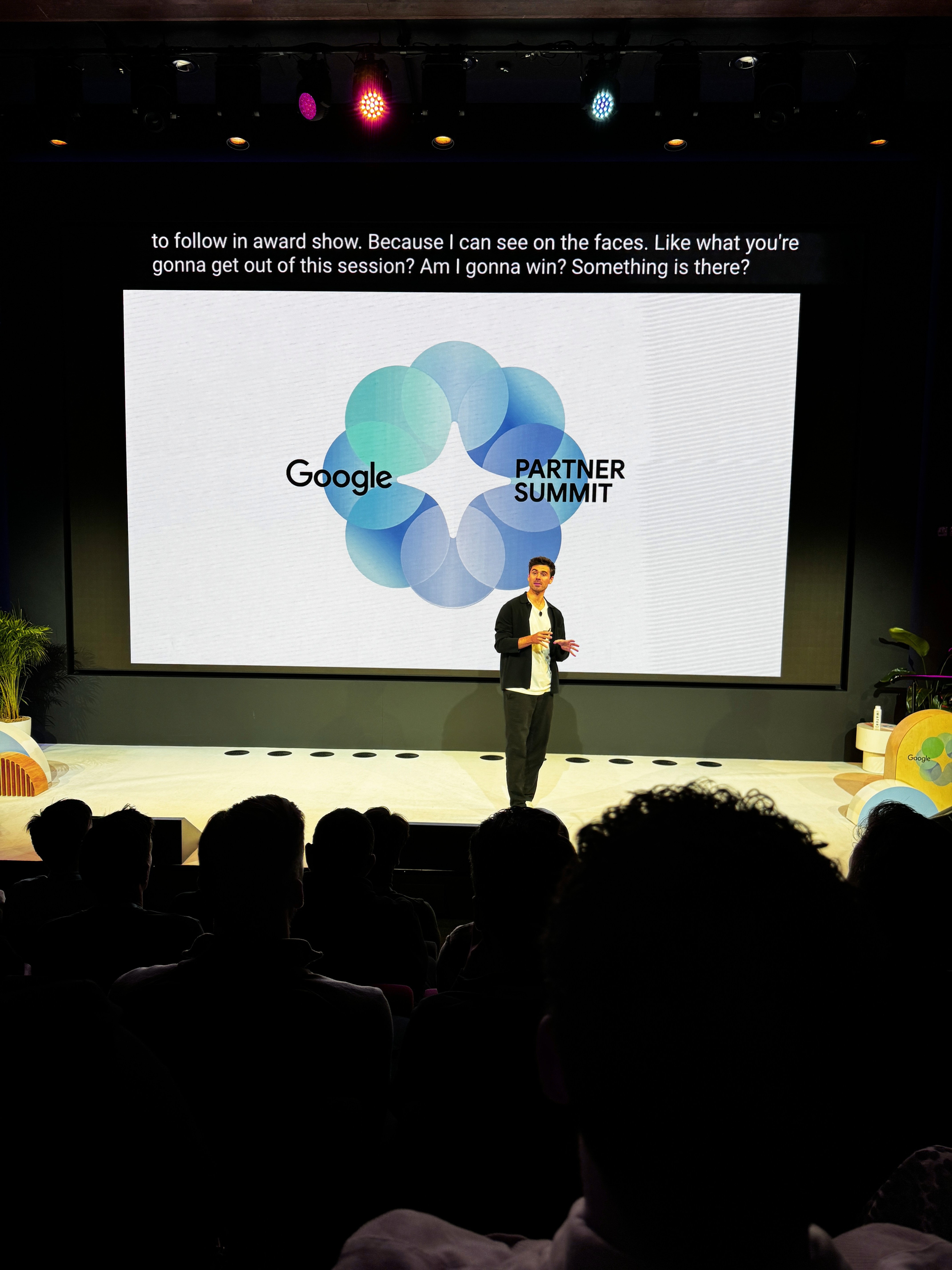
Really good to attend this year's Google Partner Summit in their European HQ in Dublin. AI everything was high on the agenda as you can imagine and we came back full of ideas for our next client campaigns

Author
Author
Oli Yeates
Oli Yeates
The summit wasn't about the promise of AI anymore; it was about the practicality of it. The key takeaway for agencies and brands alike is that we are moving past the hype cycle and into the era of operational maturity.
Here is my analysis of the critical themes from the summit and what they mean for our strategies moving forward.
The "Proof of Concept" Plateau
One of the most telling statistics shared was from a joint BCG/Google study: 74% of companies remain stuck in the "proof-of-concept" phase.
While adoption is high, scaling remains a challenge. Many organisations are treating AI as a series of isolated experiments rather than a core business driver. The summit highlighted that the barriers to scaling are rarely just technical—they are structural. Misaligned teams, unclear rollout plans, and a lack of clear business value definitions are preventing brands from turning potential into performance.
The Three Mindsets of AI Adoption
Google categorised the current market sentiment into three distinct mindsets. Understanding where your organisation sits is crucial to moving forward:
FOMO (Fear of Missing Out): Adopting tools rapidly due to competitive pressure, often without a cohesive strategy.
FOMU (Fear of Messing Up): Paralysis caused by risk aversion, often slowing down progress due to heavy governance or legal concerns.
FOMA (Focus on Maximising Advantage): The ideal state. This represents a proactive approach where AI is treated as a partner to maximise creative and analytical output.
Moving from a defensive posture (FOMU) to a strategic one (FOMA) is the defining challenge for marketers this year.
The Technology Roadmap: Google’s "Big Bets"
Google outlined four specific areas that will shape the activation landscape over the next 12 months. These are the tools we are watching closely:
AI Max: As Google’s flagship AI offering, this is expanding rapidly. We are seeing testing on "AI Mode" ads and expect significant updates regarding visual search inventory via Google Lens.
Performance Max (PMAX): Already a powerhouse for UK activation, PMAX is evolving to offer greater transparency. New reporting tools will finally give advertisers better visibility into inventory mix and outcomes—a welcome update for optimisation.
YouTube: Google described YouTube as "chronically under-invested in," despite delivering 1.4x the ROI of social media (Nielsen). Positioned as the "anchor of the funnel," new generative AI tools are set to remove the creative bottlenecks that often hinder video scaling.
Agentic AI: Looking further ahead, the focus is shifting to "Agentic AI"—systems capable of acting autonomously across platforms to improve data flow and measurement. This suggests a future where AI handles the complexity of connecting tools, allowing marketers to focus on strategy.
Measurement as the Foundation of Trust
A recurring theme was that if you cannot measure AI, you cannot trust it—and if you cannot trust it, you cannot scale it.
With attribution and cross-platform reporting still complex, Google announced new infrastructure to bridge the gap, including the Data Manager API for easier first-party data integration and the Google Tag Gateway. These tools are designed to help marketers evaluate AI not just on automation efficiency, but on tangible business impact.
The Human Element
Despite the focus on automation, the summit concluded with a strong message about the role of human judgment.
AI can scale execution, but it cannot replicate the empathy and nuance required to build brand equity. The consensus was clear: the future of advertising isn't about AI replacing human creativity, but amplifying it. Brands that succeed will be those that provide the high-quality inspiration and strategic intent that AI needs to perform.
Looking Ahead The Google Partner Summit 2025 reaffirmed that the tools for the next major transformation in marketing are already here. The competitive advantage now lies in how effectively we structure our teams and strategies to use them.
At Clicky, we are ready to help you move from "experimentation" to "advantage."
The summit wasn't about the promise of AI anymore; it was about the practicality of it. The key takeaway for agencies and brands alike is that we are moving past the hype cycle and into the era of operational maturity.
Here is my analysis of the critical themes from the summit and what they mean for our strategies moving forward.
The "Proof of Concept" Plateau
One of the most telling statistics shared was from a joint BCG/Google study: 74% of companies remain stuck in the "proof-of-concept" phase.
While adoption is high, scaling remains a challenge. Many organisations are treating AI as a series of isolated experiments rather than a core business driver. The summit highlighted that the barriers to scaling are rarely just technical—they are structural. Misaligned teams, unclear rollout plans, and a lack of clear business value definitions are preventing brands from turning potential into performance.
The Three Mindsets of AI Adoption
Google categorised the current market sentiment into three distinct mindsets. Understanding where your organisation sits is crucial to moving forward:
FOMO (Fear of Missing Out): Adopting tools rapidly due to competitive pressure, often without a cohesive strategy.
FOMU (Fear of Messing Up): Paralysis caused by risk aversion, often slowing down progress due to heavy governance or legal concerns.
FOMA (Focus on Maximising Advantage): The ideal state. This represents a proactive approach where AI is treated as a partner to maximise creative and analytical output.
Moving from a defensive posture (FOMU) to a strategic one (FOMA) is the defining challenge for marketers this year.
The Technology Roadmap: Google’s "Big Bets"
Google outlined four specific areas that will shape the activation landscape over the next 12 months. These are the tools we are watching closely:
AI Max: As Google’s flagship AI offering, this is expanding rapidly. We are seeing testing on "AI Mode" ads and expect significant updates regarding visual search inventory via Google Lens.
Performance Max (PMAX): Already a powerhouse for UK activation, PMAX is evolving to offer greater transparency. New reporting tools will finally give advertisers better visibility into inventory mix and outcomes—a welcome update for optimisation.
YouTube: Google described YouTube as "chronically under-invested in," despite delivering 1.4x the ROI of social media (Nielsen). Positioned as the "anchor of the funnel," new generative AI tools are set to remove the creative bottlenecks that often hinder video scaling.
Agentic AI: Looking further ahead, the focus is shifting to "Agentic AI"—systems capable of acting autonomously across platforms to improve data flow and measurement. This suggests a future where AI handles the complexity of connecting tools, allowing marketers to focus on strategy.
Measurement as the Foundation of Trust
A recurring theme was that if you cannot measure AI, you cannot trust it—and if you cannot trust it, you cannot scale it.
With attribution and cross-platform reporting still complex, Google announced new infrastructure to bridge the gap, including the Data Manager API for easier first-party data integration and the Google Tag Gateway. These tools are designed to help marketers evaluate AI not just on automation efficiency, but on tangible business impact.
The Human Element
Despite the focus on automation, the summit concluded with a strong message about the role of human judgment.
AI can scale execution, but it cannot replicate the empathy and nuance required to build brand equity. The consensus was clear: the future of advertising isn't about AI replacing human creativity, but amplifying it. Brands that succeed will be those that provide the high-quality inspiration and strategic intent that AI needs to perform.
Looking Ahead The Google Partner Summit 2025 reaffirmed that the tools for the next major transformation in marketing are already here. The competitive advantage now lies in how effectively we structure our teams and strategies to use them.
At Clicky, we are ready to help you move from "experimentation" to "advantage."
more BLogs
more BLogs


