Unpacking Google’s BIG December 2025 Update
Unpacking Google’s BIG December 2025 Update
Monday, January 5, 2026
While most of us were winding down for Christmas, Google was busy rolling out one of the most significant updates of the year.
While most of us were winding down for Christmas, Google was busy rolling out one of the most significant updates of the year.

Michael Scott
Michael Scott
Head of Organic
Head of Organic
Dubbed 'The Core Before Christmas' by industry experts (a nod to its unfortunate timing), the December 2025 Broad Core Update has now officially finished rolling out as of December 29th. If you noticed your analytics looking a bit volatile whilst you were out of office, you weren't imagining things.
Here is the lowdown on what happened, who felt the impact, and what this means for your 2026 SEO strategy.
Google's Christmas Gift
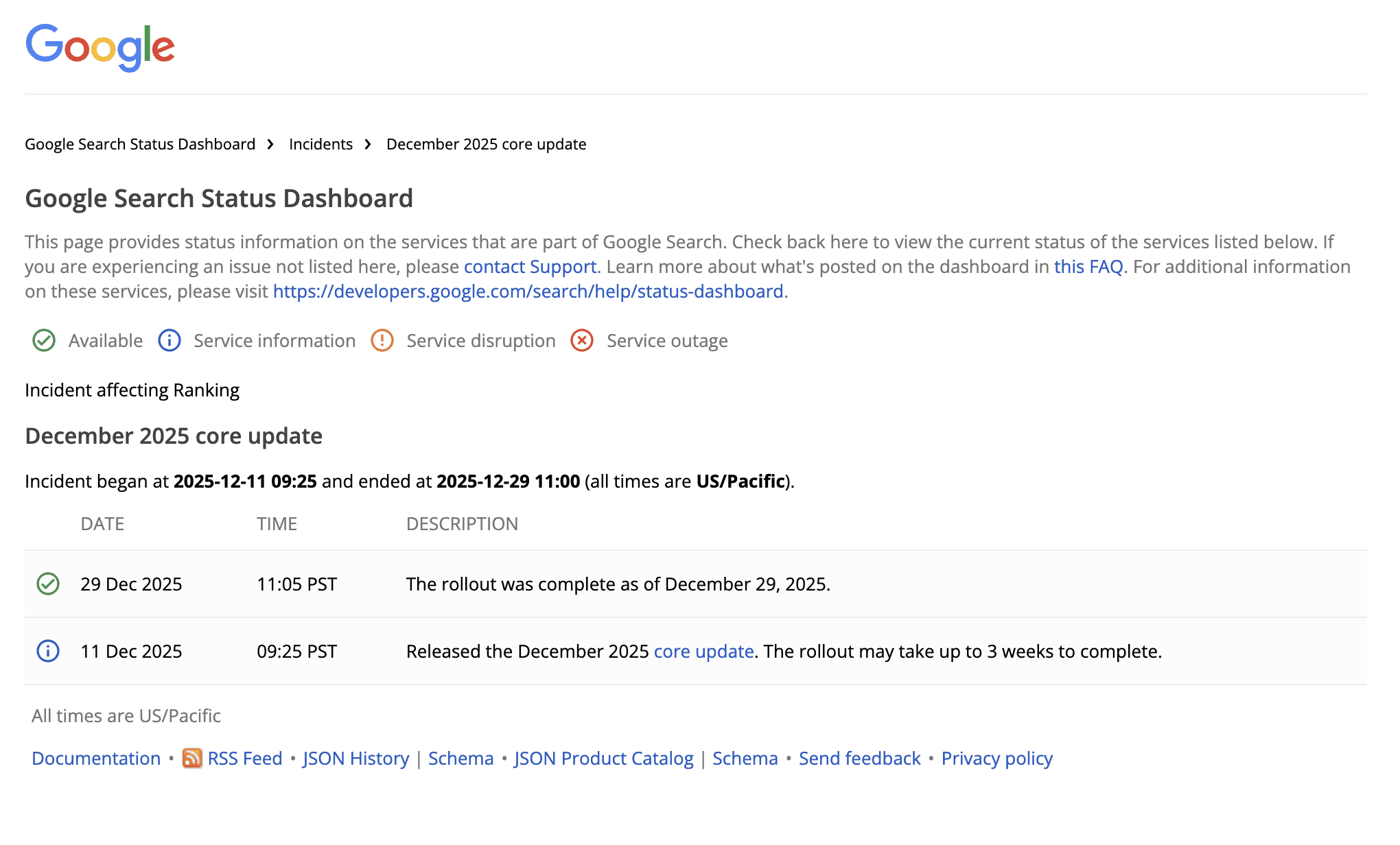
The update officially kicked off on December 11th, 2025, and took a full 18 days to complete. Launching a broad core update just weeks before Christmas is bold, even for Google, but it aligns with their push to clean up search results before the high-traffic holiday period.
You can see the full timeline on the Google Search Status Dashboard, which confirmed the rollout concluded just before New Year's Eve.
Data from the rollout shows two major tremors: one right at the start around December 13th, and a secondary spike in volatility on December 20th. If your traffic graph looks like a rollercoaster during these dates, this update is almost certainly the cause.
Who Felt the Chill?
Unlike targeted spam updates, broad core updates affect the whole web. However, early analysis shows that YMYL (Your Money Your Life) sectors took the brunt of the impact.
💰 Finance: Investment sites, personal finance blogs, and crypto platforms saw massive fluctuations.
👩🏼⚕️ Health & Medical: Informational medical sites were heavily scrutinised, with a clear preference shown for established, authoritative institutions over smaller niche blogs.
📰 News Publishers: Several major news outlets reported visibility drops, particularly within Google Discover.
Interestingly, this update also seems to have favoured YouTube content significantly, with video carousels taking up more prime real estate in search results. If you have been putting off your video strategy, consider this your warning bell.
The Rise of GEO (Generative Engine Optimisation)
Perhaps the most critical takeaway from this update is the interaction with Google’s AI features. We are seeing a distinct shift where winning in search isn't just about the 'ten blue links' anymore — it is about being cited.
The December update appears to have tightened the criteria for what content gets pulled into AI Overviews and the new AI Mode. Sites that focus on quick, factual, and highly cited answers are winning, while 'AI slop' (low-value, mass-produced content) is getting pushed further down. This reinforces the move towards Generative Engine Optimisation: optimising your content to be the source that AI quotes, rather than just a destination it links to.
What Should You Do Now?
First, take a breath. Now that the rollout is complete, the dust has settled. Here is your plan of action:
Check Your Dates: Compare your traffic drops specifically against the December 11–29 window. If the drop happened outside these dates, it might be seasonal or technical.
Audit Your E-E-A-T: With Finance and Health being hit, Google is doubling down on Experience, Expertise, Authoritativeness, and Trustworthiness. Ensure your author bios are robust and your citations are clear.
Review AI Visibility: Search for your key terms and see if an AI summary appears. If it does, analyse the sources it cites. What do they have that you don't?
As we step into 2026, the message is clear: technical excellence is the baseline, but authority is the differentiator.
Dubbed 'The Core Before Christmas' by industry experts (a nod to its unfortunate timing), the December 2025 Broad Core Update has now officially finished rolling out as of December 29th. If you noticed your analytics looking a bit volatile whilst you were out of office, you weren't imagining things.
Here is the lowdown on what happened, who felt the impact, and what this means for your 2026 SEO strategy.
Google's Christmas Gift
The update officially kicked off on December 11th, 2025, and took a full 18 days to complete. Launching a broad core update just weeks before Christmas is bold, even for Google, but it aligns with their push to clean up search results before the high-traffic holiday period.
You can see the full timeline on the Google Search Status Dashboard, which confirmed the rollout concluded just before New Year's Eve.
Data from the rollout shows two major tremors: one right at the start around December 13th, and a secondary spike in volatility on December 20th. If your traffic graph looks like a rollercoaster during these dates, this update is almost certainly the cause.
Who Felt the Chill?
Unlike targeted spam updates, broad core updates affect the whole web. However, early analysis shows that YMYL (Your Money Your Life) sectors took the brunt of the impact.
💰 Finance: Investment sites, personal finance blogs, and crypto platforms saw massive fluctuations.
👩🏼⚕️ Health & Medical: Informational medical sites were heavily scrutinised, with a clear preference shown for established, authoritative institutions over smaller niche blogs.
📰 News Publishers: Several major news outlets reported visibility drops, particularly within Google Discover.
Interestingly, this update also seems to have favoured YouTube content significantly, with video carousels taking up more prime real estate in search results. If you have been putting off your video strategy, consider this your warning bell.
The Rise of GEO (Generative Engine Optimisation)
Perhaps the most critical takeaway from this update is the interaction with Google’s AI features. We are seeing a distinct shift where winning in search isn't just about the 'ten blue links' anymore — it is about being cited.
The December update appears to have tightened the criteria for what content gets pulled into AI Overviews and the new AI Mode. Sites that focus on quick, factual, and highly cited answers are winning, while 'AI slop' (low-value, mass-produced content) is getting pushed further down. This reinforces the move towards Generative Engine Optimisation: optimising your content to be the source that AI quotes, rather than just a destination it links to.
What Should You Do Now?
First, take a breath. Now that the rollout is complete, the dust has settled. Here is your plan of action:
Check Your Dates: Compare your traffic drops specifically against the December 11–29 window. If the drop happened outside these dates, it might be seasonal or technical.
Audit Your E-E-A-T: With Finance and Health being hit, Google is doubling down on Experience, Expertise, Authoritativeness, and Trustworthiness. Ensure your author bios are robust and your citations are clear.
Review AI Visibility: Search for your key terms and see if an AI summary appears. If it does, analyse the sources it cites. What do they have that you don't?
As we step into 2026, the message is clear: technical excellence is the baseline, but authority is the differentiator.
more BLogs
more BLogs