Oli Yeates · 4 June 2026
Beyond Oasis and the Football: Manchester Is Becoming the UK's Centre of Commerce
Ask anyone what Manchester is famous for and you get music and football. But in 2026 it is fast becoming one of the UK's most important centres of commerce, with the creative and digital world right at the heart of it. Here is what the numbers actually say.
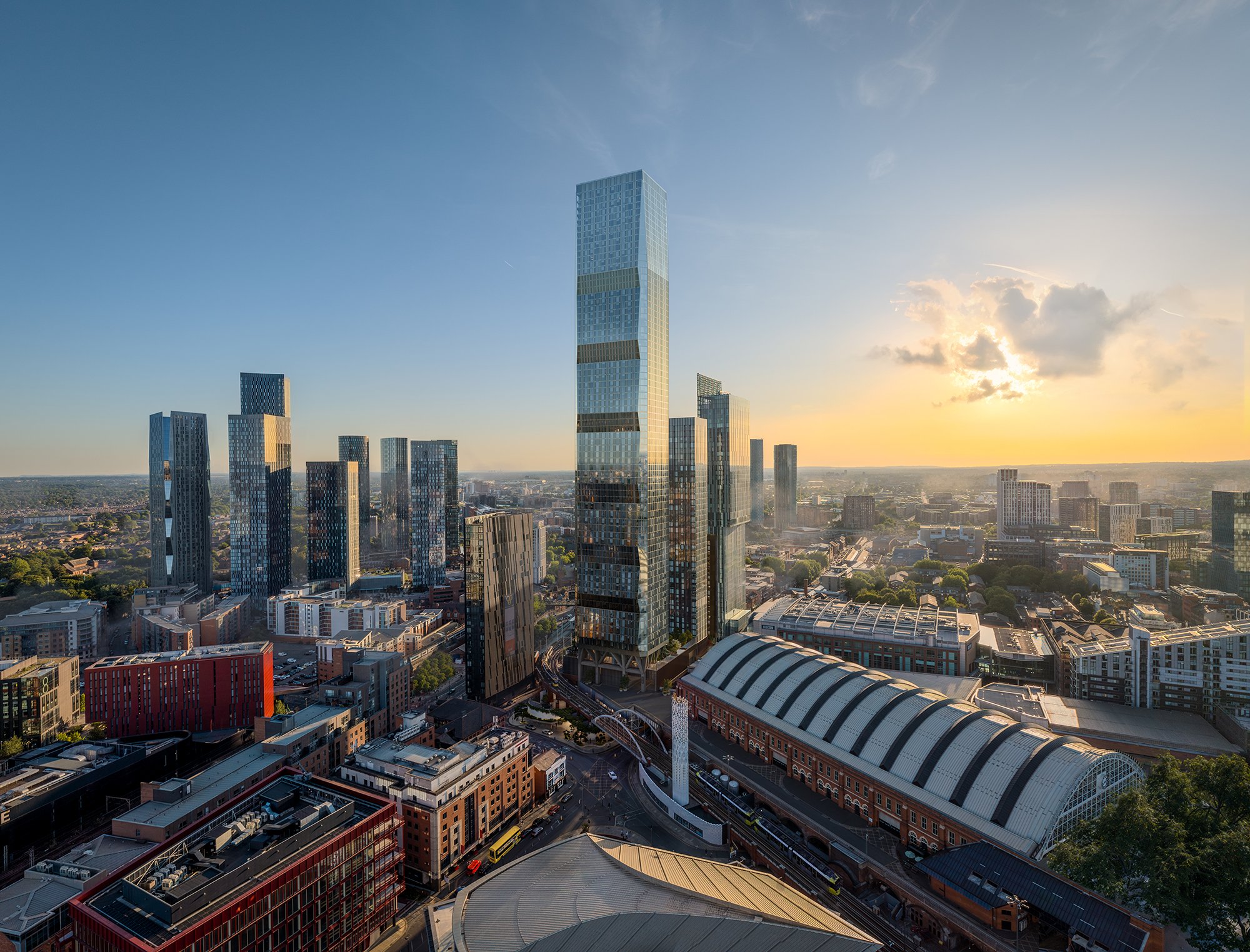
Ask anyone outside the city what Manchester is famous for and you will get the same two answers: music and football. Oasis and the Stone Roses. United and City. It is a brilliant heritage and we love it. But it sells the place short. Manchester in 2026 is not a music city with a football habit. It is fast becoming one of the most important centres of commerce in the UK, and the creative and digital world is right at the heart of it.
I can feel it from our HQ on Lever Street, slap in the middle of the Northern Quarter. Manchester used to be the city London kept half an eye on. Now it is the city London keeps losing people to. Look around: the cranes, the new campuses, the members' clubs, the big corporate names going up on Grade A towers. On its own, none of it means much. Together, it all points one way. The centre of gravity for serious commercial, creative and digital work in this country is moving north, and it is landing here.
Honestly, we can see it from our own front door. Our building is being transformed right now. B Corp workspace operator x+why is turning the ground and first floors into a new co-working space, meeting rooms and a coffee shop, while our team carries on up on the sixth floor. It opens later in 2026, and we wrote about it here. When the investment is happening in your own stairwell, it stops being a property-page headline and starts being something you walk through every morning.
Are we biased? Of course. We built this agency here. But we are not the ones making the case. The numbers are.
The digital engine is the real headline
Start with the tech sector, because that is the real story. Manchester is the biggest tech hub in the UK outside London, and it is not even close. Greater Manchester's digital and tech sector is now worth around £5 billion in annual GVA and supports more than 82,000 digital roles. Oxford Economics reckons it will grow 4.5 to 5 per cent in 2026, well ahead of the 3.2 per cent expected across the UK. While a lot of places are still talking about levelling up, Manchester is quietly compounding.
The clearest tell is who is choosing to be here. Booking.com has just finished a new Manchester campus with more than 1,300 people in it, hundreds of them hired in a single year, built around a hub of software engineers. That is not a token regional office. That is one of the biggest travel platforms on earth deciding its engineering talent should live in Manchester.
And it is in good company. Amazon has been here for years. The Co-op is headquartered here. BNY has taken a 200,000 sq ft city-centre building to get its teams under one roof. Deloitte and a long line of professional services, fintech, data and SaaS firms have put serious headcount in the centre. And homegrown names like data unicorn Matillion are hiring engineers faster than the city can train them. That is the bit that matters: this is no longer a one-trick consumer-internet town. It is finance, AI, life sciences, law and creative, all stacking up in the same few postcodes.
And it is not just about who moves in. Manchester has a habit of building digital businesses that go on to take on the world. Auto Trader turned a weekly print classifieds mag into a FTSE 100 digital marketplace worth billions, still run from Tony Wilson Place. The Hut Group, started here in 2004, grew into a global e-commerce machine behind the likes of Myprotein and Lookfantastic. Boohoo launched in 2006 out of the city's textile trade and scaled into an online fast-fashion group selling into more than 100 countries, with PrettyLittleThing and others under the same roof. AO.com famously started with a £1 bet and became one of the UK's biggest online electricals retailers. And the conveyor belt has not stopped. Adanola, the activewear brand born in Manchester in 2015, is now stocked everywhere from Harrods to a fast-growing US business. Manchester does not just attract digital businesses. It grows its own.
The office market tells the same story
You can read a city's confidence off its commercial property, and Manchester's is running hot. The first half of 2025 saw 581,542 sq ft of city-centre office space taken up across more than 100 deals. That is the strongest first half since 2019, and well over half of it was Grade A and prime. This is a flight to quality, not a scramble for cheap desks.
Demand is so strong the question has flipped from "is there enough space" to "are we about to run out". Prime rents are tipped to hit £50 per sq ft by the end of 2026. To keep up, Landsec is building The Republic at Mayfield, 243,000 sq ft with room for more than 2,000 jobs and an expected £100 million a year for the local economy. Gary Neville's St Michael's scheme is reeling in law firms like Pinsent Masons and Hill Dickinson. When the best businesses are scrapping over the best space, you are looking at a city on the up.
The investment numbers back the story up
This is where Manchester stops being a nice story and starts beating London on the spreadsheet. Take property. Official UK House Price Index figures showed London prices falling for months on end into early 2026, down around 1.7 per cent year on year, with the average home north of £550,000. Manchester, on ONS data, was going the other way, up roughly 3.9 per cent year on year at an average closer to £250,000. So Manchester is rising while London slips, and you get in at less than half the price.
The yield gap is starker still. Manchester city-centre gross rental yields sit around 6 per cent. Prime and inner London tends to land at 3 to 4 per cent gross, often dropping to 2 to 3 per cent net once the costs come out. If you are investing for income rather than prestige, that is not a close call.
The wider economy is telling the same story. Greater Manchester's economy has passed £100 billion for the first time, up around 28 per cent since devolution in 2015 and consistently beating the UK average (Deloitte's Manchester Crane Survey). EY has the city's GVA growing about 2.1 per cent a year out to 2028, well ahead of the 1.6 per cent expected nationally, with employment growth among the fastest of any UK city. London is still the bigger machine in raw terms. But on growth rate, value and yield, Manchester is the one with the wind behind it.
Soho House landing here was a statement
For years the assumption was that the serious creative networking all happened in London. That changed in November 2025, when Soho House opened its first ever House in the north of England, inside the old Granada Studios in St John's.

Do not underestimate what that signals. Soho House does not open where the creative crowd might turn up one day. It opens where they already are. The Manchester House sprawls across the old TV studios with a members' restaurant, live music, an events space and a rooftop pool that opened in spring 2026. Membership starts around £2,400 a year, and the waiting list ran into the thousands. A members' club is a bet on a city's creative future, and this was a big one.
And the fact it sits in the old Granada Studios, the home of so much British telly, is a lovely bit of continuity. Manchester has always made culture. Now the people who trade in it are putting down roots here for good.
And then there is the skyline
Want the most literal sign of ambition going? Look up. They are building Nobu Manchester right now, part of the Viadux scheme near Castlefield. A £360 million, 76-storey, 246-metre tower that will be the tallest building in the UK outside London.
It is backed by Nobu Hospitality, the brand founded by Robert De Niro, Chef Nobu Matsuhisa and Meir Teper, alongside developer Salboy. Inside: a 160-room Nobu hotel, a signature Nobu restaurant tucked under the site's Grade II listed Victorian viaduct arches, and 452 branded residences, the first Nobu residences anywhere in the UK. Ground was broken in late 2025, full construction runs through 2026, and it is due to complete in 2031. De Niro pointed to the city's character and creative energy as the reason for picking it.
When a global luxury brand like that picks Manchester for its first move outside the capital, and its first UK residences, the message could not be clearer. This is not a regional bet. It is a flagship.
Two of the biggest clubs in the world play here
You cannot talk about Manchester's global pull without talking about football. This is the home of Manchester United and Manchester City, two of the most recognised sporting brands on the planet, beamed into hundreds of millions of homes every week. Greater Manchester's mayor has said the first thing people ask him abroad is rarely about policy. It is about United or City. That is soft power most cities would pay a fortune to build, and Manchester gets it for nothing.

And the trade that flows from it is real, not romantic. Football is a genuine tourism export. VisitBritain found around 1.5 million overseas visitors took in a live UK match in 2019, spending roughly £1.4 billion, and football tourists spend about a third more per trip than the average visitor. Manchester takes a big slice of that. Matchday hotel occupancy runs near 85 per cent against roughly 70 per cent on a normal day, and Manchester City Council research puts stadium-related tourism alone at more than £120 million a year for the local economy. Set that against Greater Manchester's wider visitor economy, worth around £9 billion and supporting more than 100,000 jobs before the pandemic, and the clubs are one of the city's best front doors to the world.
For a creative and digital economy, that global familiarity is wildly underrated. When a brand, an investor or a brilliant hire already feels warm about the city, half the introduction is done before anyone opens their mouth. The two badges do a job no marketing budget ever could.
Why this matters, and not just to property pages
It would be easy to read all this as a list of shiny new buildings. It is much more than that. Capital, corporates, culture and talent are all landing in the same place at the same time, and that is exactly the mix that turns a city into a genuine creative and digital capital. The campuses pull in the engineers. The towers and the members' clubs keep them here. That density of talent draws the next wave of businesses, and round the flywheel goes.
For brands, it means the centre of the action for creative and digital work is increasingly up here, with the talent, the energy and the costs to match. For us, it is a daily reminder of why we built Clicky Group in the Northern Quarter and never left. We are not watching this from the sidelines. With our HQ in central Manchester, we are right in the thick of it, with a front-row seat as the city becomes what it always should have been.
London will always be London, and Manchester will always have the music and the football. What it has now, on top of all that, is the commerce, the capital and the talent to match. If you are betting on where the UK's most interesting creative and digital work gets made over the next decade, the smart money is heading up the M6.

If you are a Manchester business, or a national brand eyeing up the North, and you want a digital partner who actually lives here, get in touch. We would love to chat.