Mastering Creative Production at Scale: Key Takeaways from 'Create with AI'
The pace of progress in artificial intelligence is staggering. What was considered cutting-edge just a thousand days ago is now viewed as primitive. For Digital Marketing Directors and marketing leaders, the question is no longer whether to adopt AI, but how to deploy it with precision and scale.


Oli Yeates
Oli Yeates
CEO & Founder
CEO & Founder
As a 2026 Google Premier Partner, our team at Clicky gets hands-on with the tools fundamentally rewiring creative workflows. Here is a breakdown of the core strategies I shared for taking your brand's creative output to the next level.
The Evolution of Image Generation
Many marketers I speak with have experimented with AI image generation, only to be frustrated by a lack of consistency. Historically, asking an AI model to make a slight alteration to an image resulted in a completely different output.

I spent a good portion of the session exploring Google Nano Banana Pro and the newly released Nano Banana 2. These models address the consistency problem directly. They introduce native 4K resolution, flawless text rendering, and crucial character consistency. This means your teams can maintain the exact look of a model or product across multiple scenes and angles.
Driving Precision with JSON Code
To move beyond the unpredictable nature of AI and gain deterministic control, marketing teams must change how they prompt. During the event, I demonstrated a powerful technique we use at Clicky: converting imagery into JSON code.

By prompting Gemini to "turn this image into a comprehensive JSON prompt", you receive a detailed, structured code breakdown of the scene, wardrobe, lighting, and subjects. On stage, I showed how you can change a single line of code to swap a model's yellow jumper for a blue one, or change the item in their hand from a smartphone to a tablet. The rest of the image remains entirely untouched. This level of precision eliminates the costly need for reshoots when slight campaign variations are required.
Automating at Scale with Google Vertex AI
The true ROI of AI is realised when applied at scale. I walked the room through a theoretical use case for the furniture retailer Dusk to illustrate the financial impact of using Google Vertex AI.

Currently, plain product shots without human presence tend to yield lower engagement. However, adding lifestyle elements to a massive product catalogue is historically expensive. If a brand wanted to add human models to 2,500 individual sofa product shots, traditional photography and post-processing would cost an estimated $19,000.
By utilising Google Vertex AI to programmatically place AI-generated models and pets onto existing product imagery, the total API processing cost drops to roughly $600. Furthermore, this process can automatically feed these new assets back into your website's backend and output perfectly sized variations for your social media campaigns.
Navigating the 'Authenticity Deficit'
While we now possess the tools to create flawless, high-production-value imagery at the click of a button, it is vital to apply a strategic lens. I wrapped up the presentation by discussing what industry experts call "The Authenticity Deficit".
As highlighted in The Drum's Social Media Trends Report 2026, high production value is increasingly viewed by consumers as a negative signal. It screams "advertising". Conversely, low-fidelity, unpolished content screams "truth".
Recent performance data from Meta backs this up. User-Generated Content (UGC) style ads on Facebook and Instagram are currently achieving a 4x higher Click-Through Rate (CTR) and a 50% lower Cost-Per-Click (CPC) than polished, brand-generated ads.
The lesson here is clear. AI allows us to create anything we want, but the most successful brands will use these tools to execute content that feels remarkably human, imperfect, and authentic.
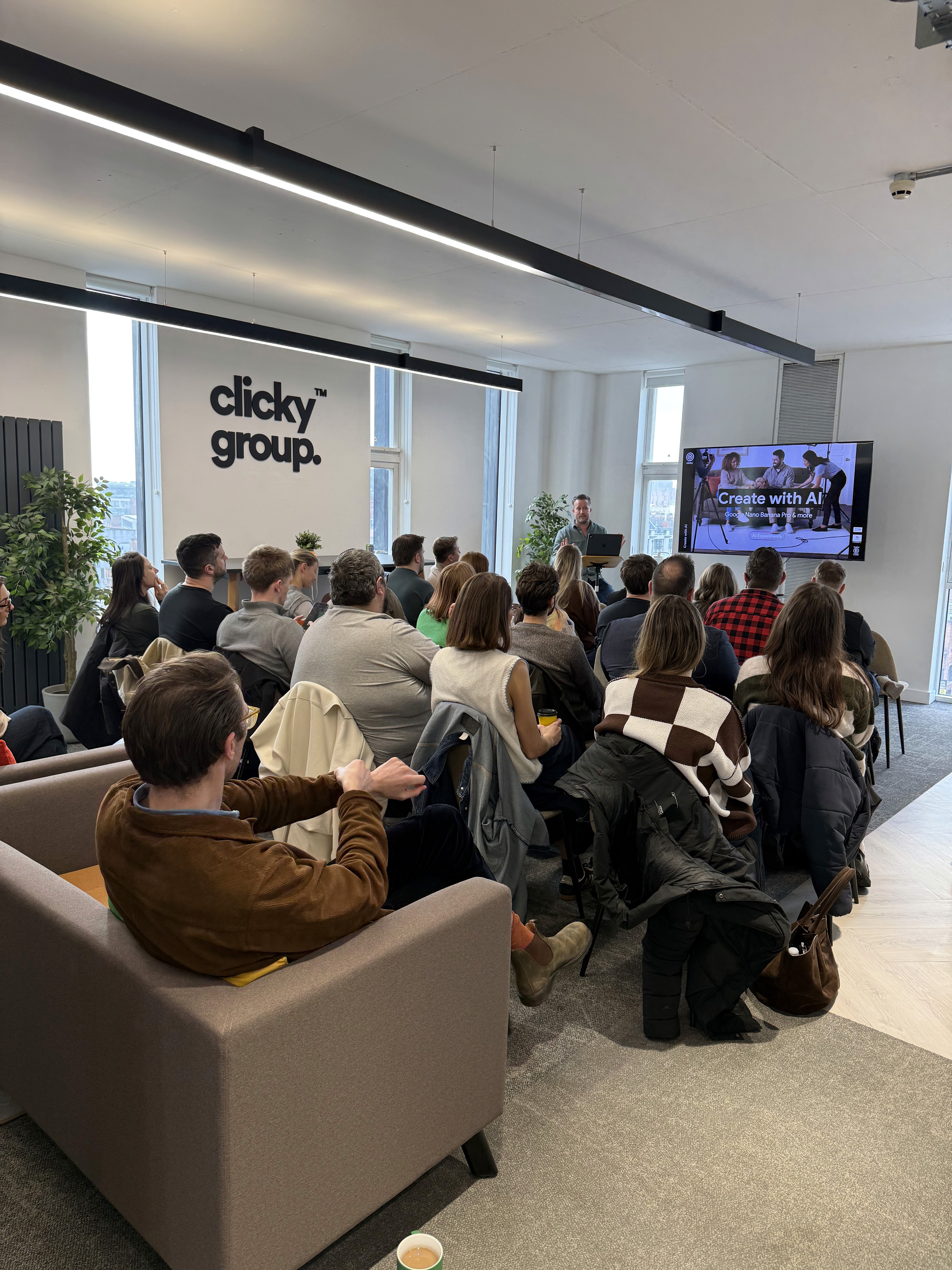
Here is some more photos from our sold out event:


As a 2026 Google Premier Partner, our team at Clicky gets hands-on with the tools fundamentally rewiring creative workflows. Here is a breakdown of the core strategies I shared for taking your brand's creative output to the next level.
The Evolution of Image Generation
Many marketers I speak with have experimented with AI image generation, only to be frustrated by a lack of consistency. Historically, asking an AI model to make a slight alteration to an image resulted in a completely different output.

I spent a good portion of the session exploring Google Nano Banana Pro and the newly released Nano Banana 2. These models address the consistency problem directly. They introduce native 4K resolution, flawless text rendering, and crucial character consistency. This means your teams can maintain the exact look of a model or product across multiple scenes and angles.
Driving Precision with JSON Code
To move beyond the unpredictable nature of AI and gain deterministic control, marketing teams must change how they prompt. During the event, I demonstrated a powerful technique we use at Clicky: converting imagery into JSON code.

By prompting Gemini to "turn this image into a comprehensive JSON prompt", you receive a detailed, structured code breakdown of the scene, wardrobe, lighting, and subjects. On stage, I showed how you can change a single line of code to swap a model's yellow jumper for a blue one, or change the item in their hand from a smartphone to a tablet. The rest of the image remains entirely untouched. This level of precision eliminates the costly need for reshoots when slight campaign variations are required.
Automating at Scale with Google Vertex AI
The true ROI of AI is realised when applied at scale. I walked the room through a theoretical use case for the furniture retailer Dusk to illustrate the financial impact of using Google Vertex AI.

Currently, plain product shots without human presence tend to yield lower engagement. However, adding lifestyle elements to a massive product catalogue is historically expensive. If a brand wanted to add human models to 2,500 individual sofa product shots, traditional photography and post-processing would cost an estimated $19,000.
By utilising Google Vertex AI to programmatically place AI-generated models and pets onto existing product imagery, the total API processing cost drops to roughly $600. Furthermore, this process can automatically feed these new assets back into your website's backend and output perfectly sized variations for your social media campaigns.
Navigating the 'Authenticity Deficit'
While we now possess the tools to create flawless, high-production-value imagery at the click of a button, it is vital to apply a strategic lens. I wrapped up the presentation by discussing what industry experts call "The Authenticity Deficit".
As highlighted in The Drum's Social Media Trends Report 2026, high production value is increasingly viewed by consumers as a negative signal. It screams "advertising". Conversely, low-fidelity, unpolished content screams "truth".
Recent performance data from Meta backs this up. User-Generated Content (UGC) style ads on Facebook and Instagram are currently achieving a 4x higher Click-Through Rate (CTR) and a 50% lower Cost-Per-Click (CPC) than polished, brand-generated ads.
The lesson here is clear. AI allows us to create anything we want, but the most successful brands will use these tools to execute content that feels remarkably human, imperfect, and authentic.
Here is some more photos from our sold out event:


more BLogs
more BLogs


