Friday, January 16, 2026
OpenAI Officially Announces Ads for ChatGPT
We said they were coming and today OpenAI have finally confirmed the introduction of ads to ChatGPT. Here is exactly how they will work...


Oli Yeates
Oli Yeates
CEO & Founder
CEO & Founder
While rumours of monetisation have circulated for months, this official update provides the first concrete details on how the platform intends to balance user experience with revenue generation. For the digital marketing industry, this marks a pivotal moment. The world’s most prominent generative AI tool is transitioning from a purely experimental utility into a viable paid media channel.

The Facts: How ChatGPT Ads Will Work
According to the announcement and subsequent blog posts from OpenAI, the rollout will begin in the US over the coming weeks. Here are the key technical details for advertisers:
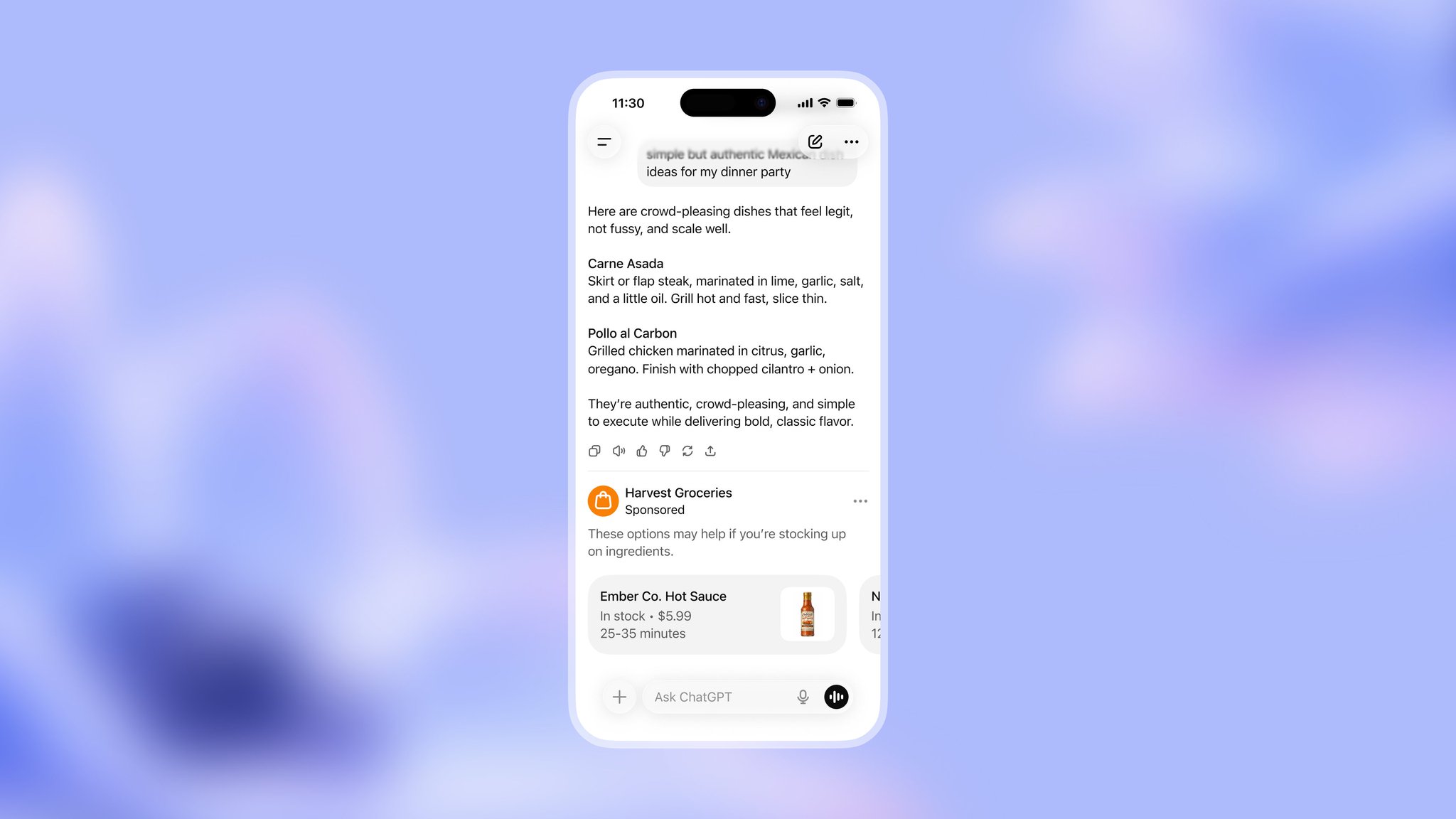
• Placement: Ads will appear at the bottom of the chat window or alongside answers, distinct from the conversational text.

• Targeting: Placements are triggered by relevance to the conversation. For example, asking for dinner ideas might surface an ad for a grocery delivery service or a specific food brand.
• Audience: Ads will strictly be shown to users on the Free tier and the newly announced ChatGPT Go plan (a lower-cost £6/$8 monthly tier). Users on Plus, Pro, and Enterprise subscriptions will remain ad-free.
• Privacy Guardrails: OpenAI has stated that advertising data will not be shared directly with third parties, and crucially, ads will not influence the generation of organic answers.
Implications for Paid Media Strategy
For our Paid Media team at Clicky, this development represents a new tier of search intent.
Traditionally, search advertising (like Google Ads) targets users at the moment of query. ChatGPT, however, captures users during a prolonged period of research and ideation. A user planning a holiday on ChatGPT isn't just searching for "flights to Spain"; they are often engaging in a multi-turn conversation about itineraries, hotels, and packing lists.
This allows for high-context placements. If a brand can appear exactly when a user is refining a specific need—rather than just at the initial broad search—the conversion potential could be significant.
Transparency and Brand Safety
One of the primary concerns for advertisers in the AI space is brand safety. OpenAI appears to be mitigating this by promising strict separation between "organic" AI advice and paid placements.

They have explicitly stated: "Answers are optimised based on what's most helpful to you. Ads are always separate and clearly labelled."
This distinction is vital. For ads to be effective in this environment, they must be viewed as additive resources rather than intrusive interruptions. If OpenAI maintains this balance, ChatGPT could become a premium environment for high-intent traffic, similar to how we currently view specific segments of the Google Display Network or Bing Chat.

What Comes Next?
We expect this initial US-only test to expand to the UK and other markets later in 2026.
As we move further into the year, integrating AI-based ad placements into a holistic digital strategy will become standard practice. We are closely monitoring the performance data from these initial tests to understand the cost-per-acquisition (CPA) and click-through rates (CTR) compared to traditional search engines.
If you would like to discuss how the changing AI landscape impacts your paid media allocation for the year ahead, speak to our specialists today.
While rumours of monetisation have circulated for months, this official update provides the first concrete details on how the platform intends to balance user experience with revenue generation. For the digital marketing industry, this marks a pivotal moment. The world’s most prominent generative AI tool is transitioning from a purely experimental utility into a viable paid media channel.

The Facts: How ChatGPT Ads Will Work
According to the announcement and subsequent blog posts from OpenAI, the rollout will begin in the US over the coming weeks. Here are the key technical details for advertisers:
• Placement: Ads will appear at the bottom of the chat window or alongside answers, distinct from the conversational text.

• Targeting: Placements are triggered by relevance to the conversation. For example, asking for dinner ideas might surface an ad for a grocery delivery service or a specific food brand.
• Audience: Ads will strictly be shown to users on the Free tier and the newly announced ChatGPT Go plan (a lower-cost £6/$8 monthly tier). Users on Plus, Pro, and Enterprise subscriptions will remain ad-free.
• Privacy Guardrails: OpenAI has stated that advertising data will not be shared directly with third parties, and crucially, ads will not influence the generation of organic answers.
Implications for Paid Media Strategy
For our Paid Media team at Clicky, this development represents a new tier of search intent.
Traditionally, search advertising (like Google Ads) targets users at the moment of query. ChatGPT, however, captures users during a prolonged period of research and ideation. A user planning a holiday on ChatGPT isn't just searching for "flights to Spain"; they are often engaging in a multi-turn conversation about itineraries, hotels, and packing lists.
This allows for high-context placements. If a brand can appear exactly when a user is refining a specific need—rather than just at the initial broad search—the conversion potential could be significant.
Transparency and Brand Safety
One of the primary concerns for advertisers in the AI space is brand safety. OpenAI appears to be mitigating this by promising strict separation between "organic" AI advice and paid placements.

They have explicitly stated: "Answers are optimised based on what's most helpful to you. Ads are always separate and clearly labelled."
This distinction is vital. For ads to be effective in this environment, they must be viewed as additive resources rather than intrusive interruptions. If OpenAI maintains this balance, ChatGPT could become a premium environment for high-intent traffic, similar to how we currently view specific segments of the Google Display Network or Bing Chat.

What Comes Next?
We expect this initial US-only test to expand to the UK and other markets later in 2026.
As we move further into the year, integrating AI-based ad placements into a holistic digital strategy will become standard practice. We are closely monitoring the performance data from these initial tests to understand the cost-per-acquisition (CPA) and click-through rates (CTR) compared to traditional search engines.
If you would like to discuss how the changing AI landscape impacts your paid media allocation for the year ahead, speak to our specialists today.
more BLogs
more BLogs


