Joe Marshall · 3 June 2026
Search Console Gen-AI Performance Reports: Tracking AI Overviews and AI Mode Visibility
Google is rolling out new gen-AI performance reports in Search Console, showing how your content appears in AI Overviews and AI Mode. Here is what data you get, what is missing, the UK-first rollout, the new opt-out toggle, and what it means for your SEO.
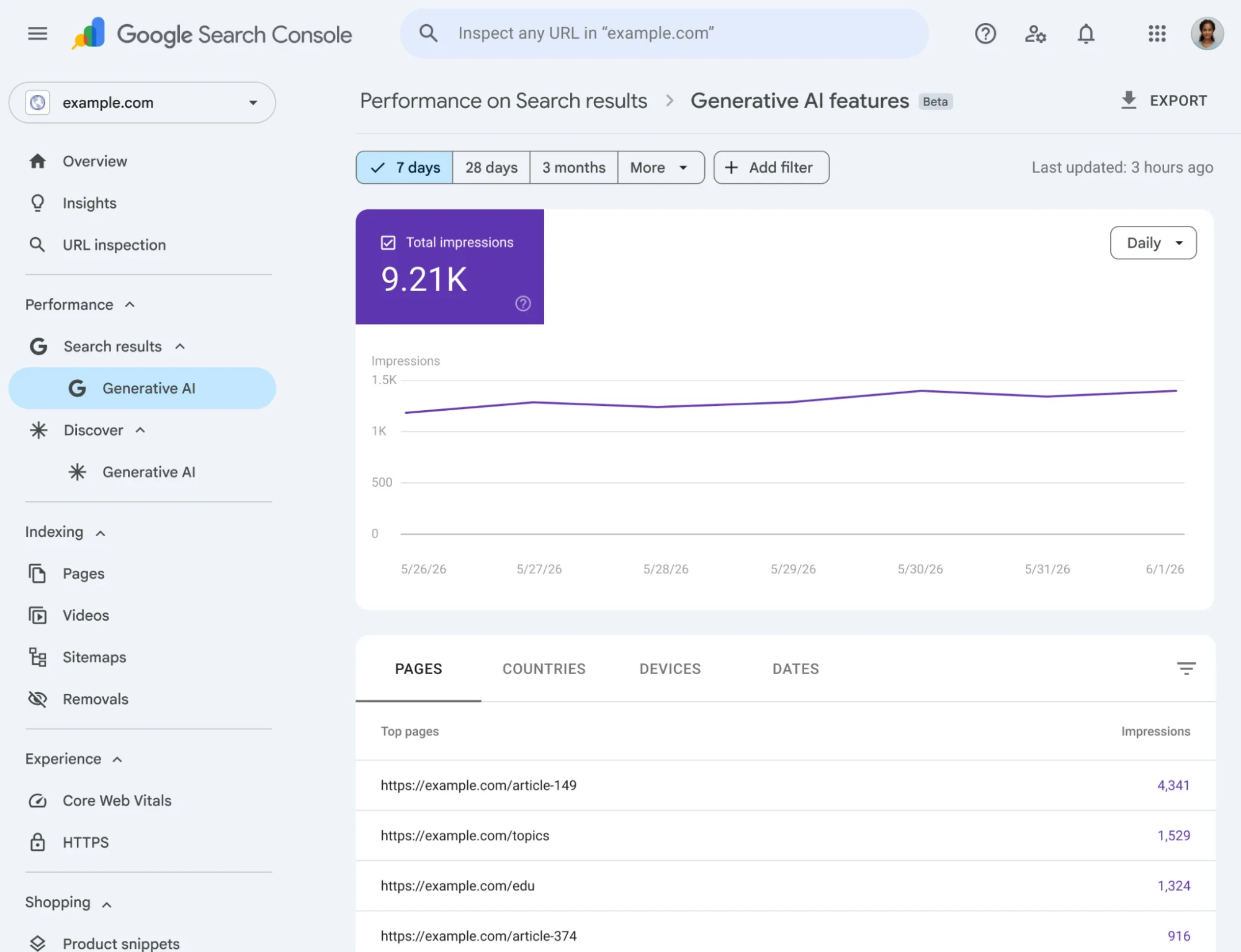
Google has started rolling out new gen-AI performance reports in Search Console, giving site owners their first proper look at how content shows up inside AI Overviews and AI Mode. For anyone who has spent the last year guessing at their AI visibility, this is a meaningful step. It is also an early, deliberately limited one, so it is worth understanding exactly what the data tells you, what it leaves out, and what to do with it. We have been asking Google for this kind of visibility for a long time, so we are pleased it has finally landed.
What Google has launched
Until now, performance inside Google's AI features has been folded into your overall Search numbers. If your page was cited in an AI Overview or surfaced in AI Mode, that activity was counted in the same pot as ordinary blue-link results, with no way to separate it out. The new report changes that by breaking out AI-feature performance as its own view, so you can finally see how often your content appears in generative AI responses rather than inferring it from total traffic.
The reporting covers the AI experiences inside Google Search: AI Overviews (the generated summaries that sit above results) and AI Mode (the conversational, fully AI-driven search experience). It is built into the existing Performance report area you already know, rather than living in a separate tool.
What data you actually get
This first version is focused on visibility, not clicks. The metrics and dimensions available are:
- Impressions: how often your URLs appeared in AI features.
- Pages: which specific URLs are showing up in AI responses.
- Countries: where that visibility is coming from.
- Devices: the device split for the activity.
- Dates: performance over time, so you can track movement.
The headline caveat: there is no click data, at least for now. Google has been explicit that more is coming, with a spokesperson saying the company is "continuing to work with website owners to understand what insights will be most helpful to inform their strategies, and we'll introduce additional metrics over time." So treat this as a foundation that will grow, not the finished article.
It is a limited rollout to start
This is not live for everyone yet. The reports are going out to a subset of website owners in the UK first, with a wider global rollout planned once Google has tested and refined things. If you do not see the report in your account yet, that is expected. It is not a sign anything is wrong, and there is nothing to switch on to force it.
The new control to opt out of AI features
Alongside the reporting, Google is testing a toggle that lets site owners stop their content from being used in AI search features, including AI Overviews, AI Mode, and AI Overviews in Discover. In Google's words, "website owners can decide if they want their site to appear in and help ground responses in our generative AI Search features."
The important detail is the trade-off. Opting out means you will not receive impressions or traffic from those AI features, but Google has confirmed it will not act as a negative ranking signal for your normal search results. In other words, choosing not to feed AI responses should not quietly demote you in the standard listings. Like the reports, this control is starting with a subset of UK site owners before any broader release.
What this means for your SEO
Three practical takeaways:
- Measurement is finally catching up. Being able to isolate AI-feature impressions, even without clicks, lets you see which pages Google is genuinely leaning on for generative answers. That is a far better signal than guessing from total traffic dips.
- Impressions without clicks need careful reading. A page can be cited heavily in AI Overviews and still send fewer visits than a classic ranking would. Until click data lands, judge AI visibility on its own terms rather than expecting it to map cleanly to sessions.
- Opting out is a real decision, not a default. For most businesses, appearing in AI responses is an opportunity, not a threat, and pulling out forfeits that exposure. There are narrow cases (highly proprietary content, for example) where it might make sense, but it should be a considered choice, not a reflex.
How we are approaching it
There are no new tricks to chase here. Eligibility for AI Overviews and AI Mode still runs on the same fundamentals as everything else: original, genuinely useful content, sound technical foundations, and clear topical authority. The new report does not change the work, it just gives us a sharper way to see whether that work is being picked up by Google's AI features. As the UK rollout reaches client accounts, we will be reviewing AI-feature visibility alongside the usual rankings and traffic, and folding any additional metrics into reporting as Google releases them.
If you would like us to check whether the new report is live in your Search Console and walk you through what your AI visibility looks like, just get in touch.