The State of SEO in 2026: What Actually Matters Now

The State of SEO in 2026: What Actually Matters Now

If you work in digital marketing, you have probably noticed something over the past twelve months: the SEO landscape has shifted more dramatically than at any point since the early days of Google itself. Between AI Overviews dominating search results, a string of major algorithm updates, and the rise of entirely new search platforms like ChatGPT and Perplexity, it is fair to say that the old playbook needs a serious rewrite.
If you work in digital marketing, you have probably noticed something over the past twelve months: the SEO landscape has shifted more dramatically than at any point since the early days of Google itself. Between AI Overviews dominating search results, a string of major algorithm updates, and the rise of entirely new search platforms like ChatGPT and Perplexity, it is fair to say that the old playbook needs a serious rewrite.

Michael Scott

Michael Scott

Head of Organic

Head of Organic

If you work in digital marketing, you have probably noticed something over the past twelve months: the SEO landscape has shifted more dramatically than at any point since the early days of Google itself. Between AI Overviews dominating search results, a string of major algorithm updates, and the rise of entirely new search platforms like ChatGPT and Perplexity, it is fair to say that the old playbook needs a serious rewrite.

But here is the thing. For all the noise about SEO being "dead," the fundamentals have not disappeared. They have evolved. And the businesses getting results right now are the ones that understand the difference between what has genuinely changed and what is simply being repackaged as new.

At Clicky, we have been delivering SEO for major brands since 2007. From household names like Redrow, Raleigh, and Panasonic through to ambitious scale-ups, we have navigated every major algorithm shift Google has thrown at us over the past 18 years. That perspective matters right now, because what we are seeing in 2026 is not just another incremental update. It is a genuine step change. Here is what is actually happening on the ground.

AI Overviews Have Changed the Click Economy

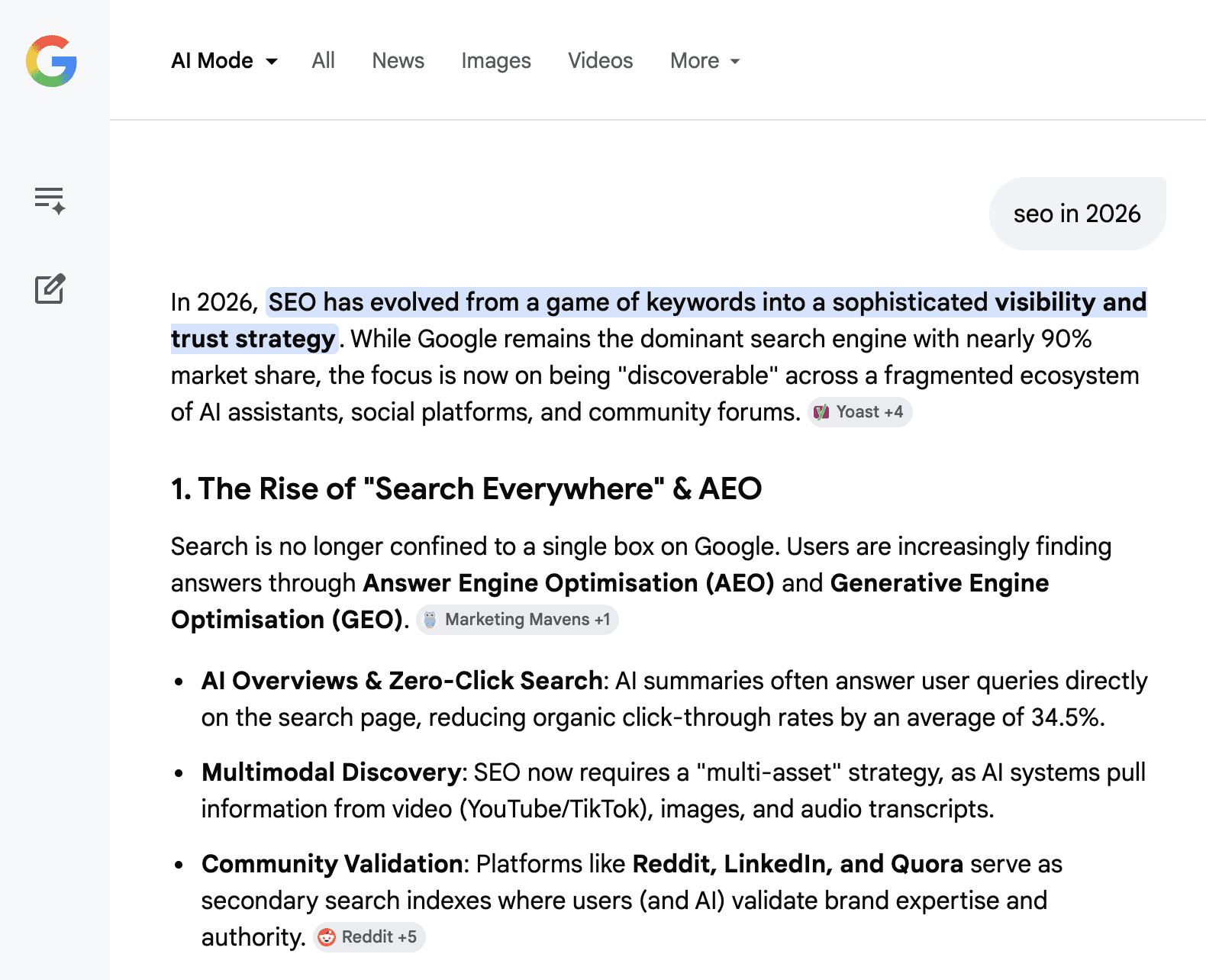
Let's start with the biggest shift. Google's AI Overviews now appear in roughly a quarter of all US searches, and the figure is climbing in the UK too. For informational queries, that number jumps to nearly 40%. The result? Organic click-through rates have taken a significant hit. Some studies suggest drops of over 30% when an AI Overview is present, with certain sectors experiencing even steeper declines.

For businesses, the implication is clear: ranking on page one is no longer enough on its own. You can hold position one and still see traffic fall if Google is answering the query directly in the search results.

That does not mean SEO is pointless. It means the goal has expanded. Alongside rankings, you now need to think about whether your content is being cited within AI-generated summaries, whether your brand appears across multiple search platforms, and whether you are creating content that AI systems actually want to reference.

The March 2026 Core Update Reinforced What Google Wants

Google's March 2026 core update, which finished rolling out this week, was one of the most volatile in recent memory. Early data suggests over half of monitored sites saw noticeable ranking movement.

The winners shared a common thread: original, experience-led content that could not easily be found elsewhere. Niche publishers, businesses investing in their own research and case studies, and sites with strong editorial standards came out ahead.

On the losing side? Mass-produced AI content without editorial oversight, thin affiliate pages, and websites that prioritised volume over depth. Google is getting far better at distinguishing between content that genuinely adds something to the conversation and content that simply repackages what already exists.

For brands, the takeaway is straightforward. If your content strategy is built on churning out generic blog posts at scale, it is time to rethink. Quality, depth, and genuine expertise are what the algorithm is rewarding. We have seen this play out first-hand across our client base, where the sites with strong editorial foundations and original insights held firm while competitors relying on volume took a hit.

E-E-A-T Is No Longer Optional

Experience, Expertise, Authoritativeness, and Trustworthiness have been part of Google's quality guidelines for years, but in 2026 they carry more weight than ever. This is partly because AI systems rely on trust signals to decide which sources to cite, and partly because Google's core updates are increasingly favouring brands with demonstrable credibility.

In practical terms, this means:

  • Author bios matter. Google wants to know who is writing your content and whether they have relevant credentials.

  • Third-party validation counts. Reviews, mentions in industry press, podcast appearances, and links from authoritative domains all contribute to your brand's perceived trustworthiness.

  • First-hand experience is king. Content written from genuine experience consistently outperforms generic advice. If you have run the campaign, used the product, or solved the problem, say so.

Structured Data Has Become a Baseline Requirement

Schema markup used to be a nice-to-have for most businesses. In 2026, it is becoming essential. AI systems, whether Google's or third-party platforms like ChatGPT and Perplexity, rely heavily on structured data to parse and understand content. Without it, your content is harder for machines to interpret, which means it is less likely to be cited or surfaced.

For e-commerce brands, product schema covering pricing, availability, and reviews is now critical for visibility in AI-powered shopping experiences. For service businesses, FAQ schema, organisation markup, and local business schema all help AI systems understand who you are and what you offer.

The good news is that implementing structured data is a relatively low-effort, high-reward activity. If your site is not already using it comprehensively, this should be near the top of your priority list.

Search Is No Longer Just Google

One of the most significant shifts in 2026 is the fragmentation of search itself. While Google still processes the vast majority of search queries, platforms like ChatGPT, Perplexity, and Microsoft Copilot are handling billions of queries that never touch a traditional search engine.

This means your SEO strategy can no longer focus exclusively on Google rankings. Increasingly, the question is whether your brand is visible across the full ecosystem of places where people look for answers. That includes AI search platforms, but also Reddit, YouTube, TikTok, and industry-specific forums where AI systems often source their responses.

The brands that are winning in 2026 are the ones showing up consistently across multiple platforms, not just optimising a single channel.

What to Actually Do About All of This

If this all sounds overwhelming, it does not need to be. The fundamentals of good SEO have not vanished. They have simply been layered with new requirements. Here is where we would suggest focusing your energy:

Audit your content for originality. Look at your top-performing pages and ask whether they offer something unique. Original data, proprietary insights, real case studies, and expert commentary are what both Google and AI systems reward. If your content reads like a rewrite of the top ten results, it is vulnerable.

Invest in your brand, not just your keywords. Brand signals are becoming increasingly important in how both Google and AI platforms determine authority. Building mentions, earning press coverage, appearing on podcasts, and growing your presence across social platforms all feed into this.

Get your technical house in order. Structured data, clean site architecture, fast page speeds, and mobile optimisation remain the foundation. AI systems favour content that is easy to crawl, parse, and understand.

Track new metrics alongside old ones. Traditional rankings and traffic still matter, but start monitoring AI citation frequency, brand mentions across platforms, and referral traffic from AI search tools. The measurement framework for SEO is expanding and your reporting should keep pace.

Create content for humans first, machines second. This has always been good advice, but it has never been more relevant. AI systems are trained to identify and reward content that genuinely helps people. Write for your audience. Structure it clearly. Make it easy to understand. The machines will follow.

The Bottom Line

SEO in 2026 is more complex than it was a year ago. There is no getting around that. But having worked in this space since 2007 and helped brands like Redrow, Raleigh, and Panasonic adapt through every major shift along the way, we can say with confidence that the businesses treating this complexity as an opportunity rather than a threat are the ones pulling ahead.

The core principles have not changed: create genuinely useful content, build real authority, and make your site technically excellent. What has changed is the breadth of platforms you need to consider, the depth of quality required, and the sophistication of how search engines evaluate trust.

If your current approach is not delivering the results it used to, that is not a sign that SEO is broken. It is a sign that SEO has moved on, and your strategy needs to move with it.

Need help navigating the new SEO landscape? Get in touch with our team to find out how we can help your business stay visible in 2026 and beyond.

If you work in digital marketing, you have probably noticed something over the past twelve months: the SEO landscape has shifted more dramatically than at any point since the early days of Google itself. Between AI Overviews dominating search results, a string of major algorithm updates, and the rise of entirely new search platforms like ChatGPT and Perplexity, it is fair to say that the old playbook needs a serious rewrite.

But here is the thing. For all the noise about SEO being "dead," the fundamentals have not disappeared. They have evolved. And the businesses getting results right now are the ones that understand the difference between what has genuinely changed and what is simply being repackaged as new.

At Clicky, we have been delivering SEO for major brands since 2007. From household names like Redrow, Raleigh, and Panasonic through to ambitious scale-ups, we have navigated every major algorithm shift Google has thrown at us over the past 18 years. That perspective matters right now, because what we are seeing in 2026 is not just another incremental update. It is a genuine step change. Here is what is actually happening on the ground.

AI Overviews Have Changed the Click Economy

Let's start with the biggest shift. Google's AI Overviews now appear in roughly a quarter of all US searches, and the figure is climbing in the UK too. For informational queries, that number jumps to nearly 40%. The result? Organic click-through rates have taken a significant hit. Some studies suggest drops of over 30% when an AI Overview is present, with certain sectors experiencing even steeper declines.

For businesses, the implication is clear: ranking on page one is no longer enough on its own. You can hold position one and still see traffic fall if Google is answering the query directly in the search results.

That does not mean SEO is pointless. It means the goal has expanded. Alongside rankings, you now need to think about whether your content is being cited within AI-generated summaries, whether your brand appears across multiple search platforms, and whether you are creating content that AI systems actually want to reference.

The March 2026 Core Update Reinforced What Google Wants

Google's March 2026 core update, which finished rolling out this week, was one of the most volatile in recent memory. Early data suggests over half of monitored sites saw noticeable ranking movement.

The winners shared a common thread: original, experience-led content that could not easily be found elsewhere. Niche publishers, businesses investing in their own research and case studies, and sites with strong editorial standards came out ahead.

On the losing side? Mass-produced AI content without editorial oversight, thin affiliate pages, and websites that prioritised volume over depth. Google is getting far better at distinguishing between content that genuinely adds something to the conversation and content that simply repackages what already exists.

For brands, the takeaway is straightforward. If your content strategy is built on churning out generic blog posts at scale, it is time to rethink. Quality, depth, and genuine expertise are what the algorithm is rewarding. We have seen this play out first-hand across our client base, where the sites with strong editorial foundations and original insights held firm while competitors relying on volume took a hit.

E-E-A-T Is No Longer Optional

Experience, Expertise, Authoritativeness, and Trustworthiness have been part of Google's quality guidelines for years, but in 2026 they carry more weight than ever. This is partly because AI systems rely on trust signals to decide which sources to cite, and partly because Google's core updates are increasingly favouring brands with demonstrable credibility.

In practical terms, this means:

  • Author bios matter. Google wants to know who is writing your content and whether they have relevant credentials.

  • Third-party validation counts. Reviews, mentions in industry press, podcast appearances, and links from authoritative domains all contribute to your brand's perceived trustworthiness.

  • First-hand experience is king. Content written from genuine experience consistently outperforms generic advice. If you have run the campaign, used the product, or solved the problem, say so.

Structured Data Has Become a Baseline Requirement

Schema markup used to be a nice-to-have for most businesses. In 2026, it is becoming essential. AI systems, whether Google's or third-party platforms like ChatGPT and Perplexity, rely heavily on structured data to parse and understand content. Without it, your content is harder for machines to interpret, which means it is less likely to be cited or surfaced.

For e-commerce brands, product schema covering pricing, availability, and reviews is now critical for visibility in AI-powered shopping experiences. For service businesses, FAQ schema, organisation markup, and local business schema all help AI systems understand who you are and what you offer.

The good news is that implementing structured data is a relatively low-effort, high-reward activity. If your site is not already using it comprehensively, this should be near the top of your priority list.

Search Is No Longer Just Google

One of the most significant shifts in 2026 is the fragmentation of search itself. While Google still processes the vast majority of search queries, platforms like ChatGPT, Perplexity, and Microsoft Copilot are handling billions of queries that never touch a traditional search engine.

This means your SEO strategy can no longer focus exclusively on Google rankings. Increasingly, the question is whether your brand is visible across the full ecosystem of places where people look for answers. That includes AI search platforms, but also Reddit, YouTube, TikTok, and industry-specific forums where AI systems often source their responses.

The brands that are winning in 2026 are the ones showing up consistently across multiple platforms, not just optimising a single channel.

What to Actually Do About All of This

If this all sounds overwhelming, it does not need to be. The fundamentals of good SEO have not vanished. They have simply been layered with new requirements. Here is where we would suggest focusing your energy:

Audit your content for originality. Look at your top-performing pages and ask whether they offer something unique. Original data, proprietary insights, real case studies, and expert commentary are what both Google and AI systems reward. If your content reads like a rewrite of the top ten results, it is vulnerable.

Invest in your brand, not just your keywords. Brand signals are becoming increasingly important in how both Google and AI platforms determine authority. Building mentions, earning press coverage, appearing on podcasts, and growing your presence across social platforms all feed into this.

Get your technical house in order. Structured data, clean site architecture, fast page speeds, and mobile optimisation remain the foundation. AI systems favour content that is easy to crawl, parse, and understand.

Track new metrics alongside old ones. Traditional rankings and traffic still matter, but start monitoring AI citation frequency, brand mentions across platforms, and referral traffic from AI search tools. The measurement framework for SEO is expanding and your reporting should keep pace.

Create content for humans first, machines second. This has always been good advice, but it has never been more relevant. AI systems are trained to identify and reward content that genuinely helps people. Write for your audience. Structure it clearly. Make it easy to understand. The machines will follow.

The Bottom Line

SEO in 2026 is more complex than it was a year ago. There is no getting around that. But having worked in this space since 2007 and helped brands like Redrow, Raleigh, and Panasonic adapt through every major shift along the way, we can say with confidence that the businesses treating this complexity as an opportunity rather than a threat are the ones pulling ahead.

The core principles have not changed: create genuinely useful content, build real authority, and make your site technically excellent. What has changed is the breadth of platforms you need to consider, the depth of quality required, and the sophistication of how search engines evaluate trust.

If your current approach is not delivering the results it used to, that is not a sign that SEO is broken. It is a sign that SEO has moved on, and your strategy needs to move with it.

Need help navigating the new SEO landscape? Get in touch with our team to find out how we can help your business stay visible in 2026 and beyond.

more BLogs

more BLogs