Oli Yeates ·
Is your 2027 marketing budget ready for how people search now?
Most 2027 marketing plans will be signed off in the next 6 weeks, and many still assume buyers click one of 10 blue links. Here's what has shifted across search, paid, social, web, email and creative since 2023, and 5 questions to ask before you sign anything off.
Most 2027 marketing plans will be signed off in the next 6 weeks. Many of them will look a lot like 2026's plan, which looked a lot like 2025's. Same channels, same split, a few percent added for inflation.
The problem is that the way people find and choose businesses has changed more in the last 3 years than in the decade before it. If your budget still assumes buyers type a query into Google, scan 10 blue links and click one, it is built on 2023 assumptions.
This is the moment to challenge that. Here is what has shifted, and 5 questions worth asking before you sign anything off.
What's changed since 2023
The short version: ranking well no longer guarantees the click, paid clicks cost more, and a growing share of buyers ask an AI assistant before they ever reach your website.
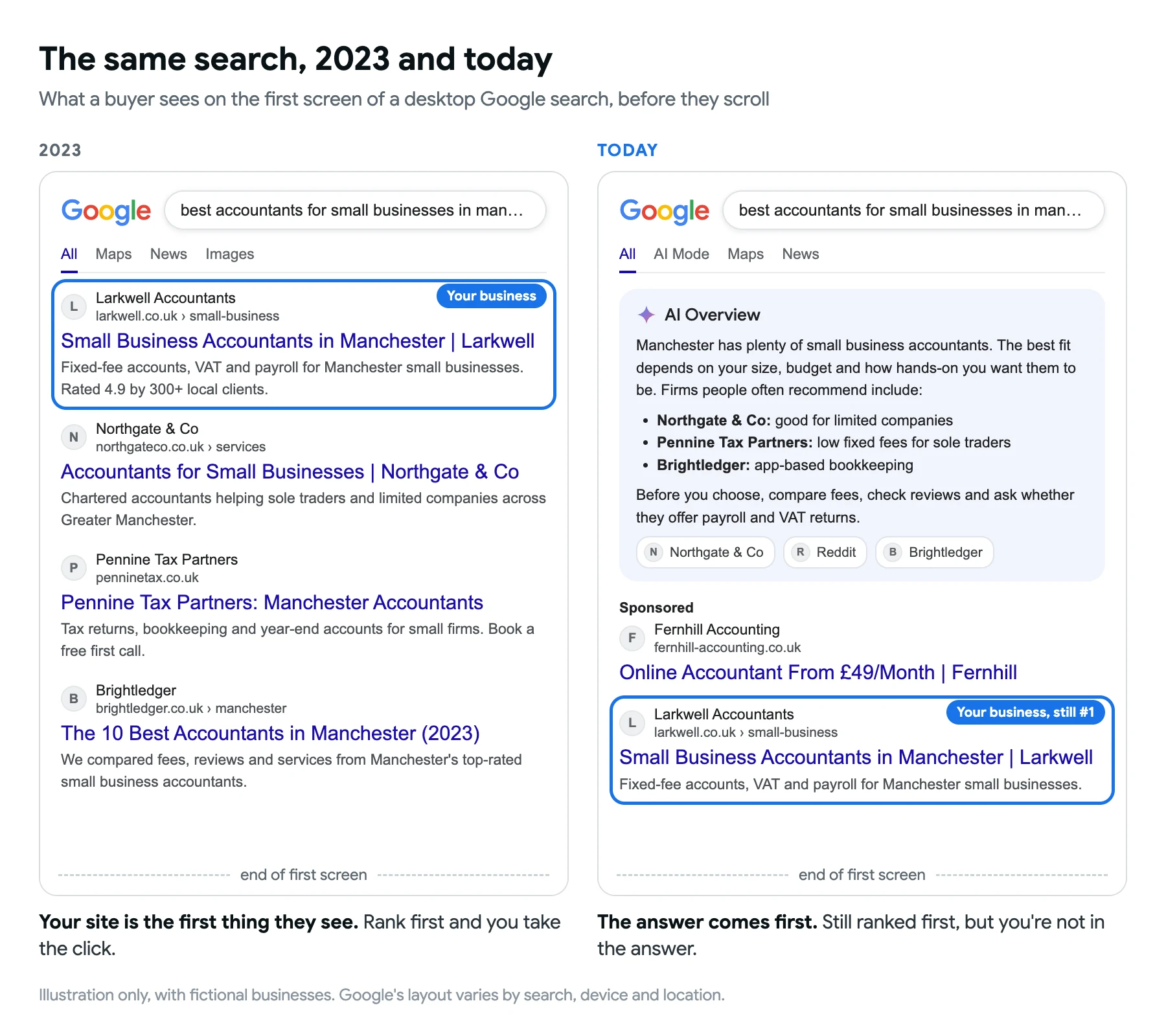
Ranking first is worth less than it was. Ahrefs analysed 300,000 keywords and found that where an AI Overview appears, the top-ranking page now gets 58% fewer clicks than it did in December 2023. Even position 10 loses nearly 20%. (Ahrefs via SEO Worth It)
Most searches now end on Google. SparkToro's early 2026 data shows 68% of US Google searches ended without a click to any website. (TechWyse)
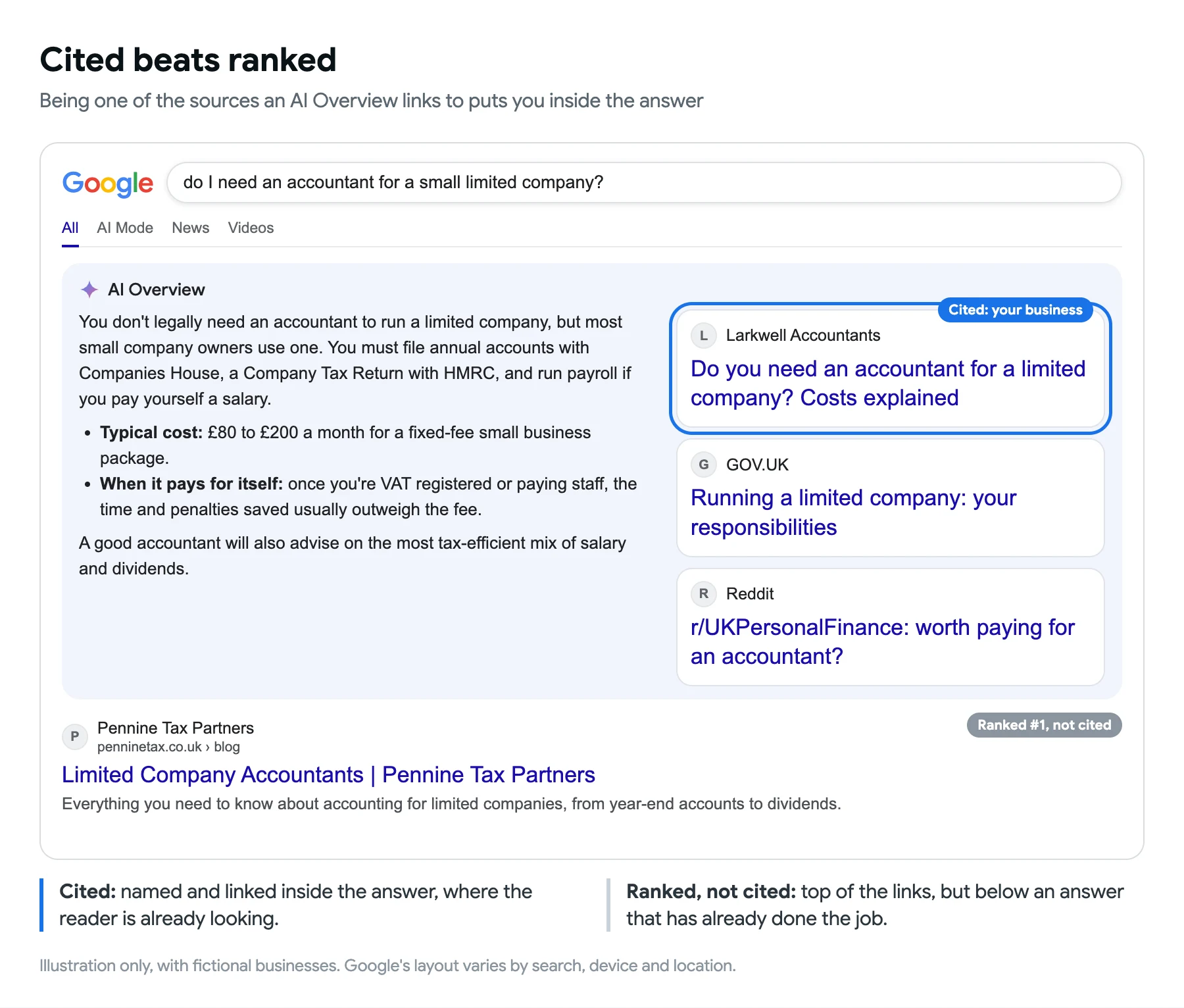
Being cited matters more than being ranked. Seer Interactive found pages cited inside an AI Overview earn more than twice the click-through rate of uncited pages on the same results page. Searches with no AI Overview have become more valuable, not less. (Search Engine Land)
AI assistants are now mainstream in the UK. Around 29.6 million people in the UK used AI tools in July 2026, and 75% of online adults read AI search summaries at least sometimes. (ProfileTree, citing Ofcom and UKOM)
Paid search costs keep climbing. LocaliQ's benchmark of 16,000+ campaigns found average cost per click rose in 87% of industries in 2025, with some sectors such as beauty jumping 60%. Conversion rates improved, but not by enough to offset the rise for most advertisers. (Search Engine Land)
None of this means SEO or paid search is dead. It means the return on each pound has shifted, and a budget that hasn't moved with it is quietly underperforming.
Beyond search: the rest of the mix has moved too
Search gets the headlines, but every other line in the budget has shifted as well. Here is what we're seeing across the channels most UK businesses rely on.
Paid search
Paid hasn't been squeezed the way organic has. Seer Interactive found that when an AI Overview appears, paid click-through rates actually rose slightly, from 14.6% to 16.2%. (Search Engine Land) The catch is cost. With CPCs still climbing, paid search rewards tight targeting and strong landing pages more than ever, and punishes lazy broad-match campaigns.
Paid social
Meta's average price per ad was up 12% year on year in both Q1 and Q2 2026, according to the company's own earnings figures. Meta also says advertisers now see $4.13 back for every $1 spent, up 25% since 2022. (Marketing Brew) Both can be true: it costs more to show up, but campaigns that get the creative and audience right are returning more. With targeting increasingly handed to Meta's automation, creative has become the main lever advertisers still control.
Website and conversion rate optimisation
If fewer people click through, each visit is worth more. AI referrals are a small share of traffic but tend to arrive further along: one 2025 study found ChatGPT referral traffic converted 31% better than non-branded organic search. (Search Engine Land via Pulse) A slow, cluttered or insecure website wastes those visitors. In 2027, CRO and site performance deserve a budget line of their own, not whatever is left over.
Email, CRM and first-party data
The audiences you own are the ones no algorithm can take away. The DMA's 2026 email benchmarking report points to improving deliverability, falling unsubscribe rates and record click-through rates. (DMA) As paid reach gets more expensive and organic clicks get scarcer, turning one-off visitors into subscribers and customers into repeat buyers is one of the best returns in the plan.
Creative, content and AI video
AI has made content cheap to produce, which means generic content is now worth almost nothing. What stands out is creative with a point of view: original research, real expertise, and video that feels made for the brand rather than generated in bulk. AI video tools have cut production time dramatically, so the budget question is no longer "can we afford video?" but "how many variations should we be testing?"
5 questions to ask before you sign off your 2027 plan
- What does an AI assistant say when someone asks for a business like ours? Ask ChatGPT, Gemini and Perplexity the 10 questions your best customers ask before they buy. If you're not mentioned, or a competitor is, that's a gap no ranking report will show you.
- Which of our keywords now trigger an AI Overview, and what happened to their clicks? Rankings can hold steady while traffic falls. Check Search Console for queries where impressions are flat or rising but clicks have dropped. That's where the money is leaking.
- Are we still paying for clicks we'd have got anyway? With CPCs up, branded and low-intent terms deserve a hard look. Test pulling back where organic or AI visibility is strong, and move that spend to high-intent searches that still convert.
- Is our content built to be quoted, or just to rank? AI answers favour content that is specific, clearly structured and backed by evidence: original data, named experts, clear comparisons. Thin, generic blog posts are the first casualty of zero-click search.
- Are we measuring influence, or only last-click conversions? If a buyer meets your brand in an AI answer, then searches your name a week later, last-click reporting gives all the credit to branded search. Build in brand search volume, AI visibility and assisted conversions, or you'll cut the activity that's actually working. The same applies to paid social and video, which rarely get last-click credit but often start the journey.
AI answers are most common exactly where buyers are weighing up options, which is why questions 1 and 4 matter most.
What a 2027-ready budget looks like
A 2027-ready budget isn't necessarily bigger. It's split around how buyers actually find you now.
| Budget line | 2023 thinking | 2027 thinking |
|---|---|---|
| SEO | Rank for as many keywords as possible | Win the queries that still drive clicks, and get cited in AI answers for the rest |
| Content | Volume of blog posts | Fewer, deeper pieces with original data and named expertise |
| Paid search | Bid on everything, including your own brand | Focus spend on high-intent terms; test cutting brand where visibility is strong |
| Brand | Nice to have, first to be cut | The thing AI assistants and searchers remember; protect it |
| Website | Traffic destination | Conversion engine for fewer, better-qualified visitors |
| Measurement | Last-click conversions and rankings | AI visibility, brand search growth, assisted conversions and revenue |
| Paid social | Tightly targeted audiences, a few hero ads | Broad audiences led by the algorithm; creative volume and testing do the targeting |
| Email and CRM | Monthly newsletter to whoever signed up | Owned audience as a core asset: capture, segment and nurture every visitor you paid to attract |
| Creative and video | Occasional shoots, expensive to produce | Always-on, AI-assisted production with many variations tested |
Before you sign it off
The businesses that win in 2027 won't be the ones that spend the most. They'll be the ones that noticed the ground had moved and adjusted their budget before their competitors did.
If you'd like a second pair of eyes on your 2027 plan, we'll run your top buyer questions through the main AI assistants, show you where your search budget is leaking, and give you a clear view of what to change. Get in touch with the Clicky team.
Sources
- Ahrefs AI Overviews CTR study, Feb 2026 (via SEO Worth It)
- SparkToro zero-click data, 2026 (via TechWyse)
- Seer Interactive AI Overview CTR update, 2026 (Search Engine Land)
- UK AI search statistics, citing Ofcom and UKOM (ProfileTree)
- LocaliQ Google Ads benchmarks 2025 (Search Engine Land)
- Meta ad prices, Oct 2026 (Marketing Brew)
- Visibility Labs ChatGPT referral conversion study (via Pulse)
- DMA Email Benchmarking Report 2026